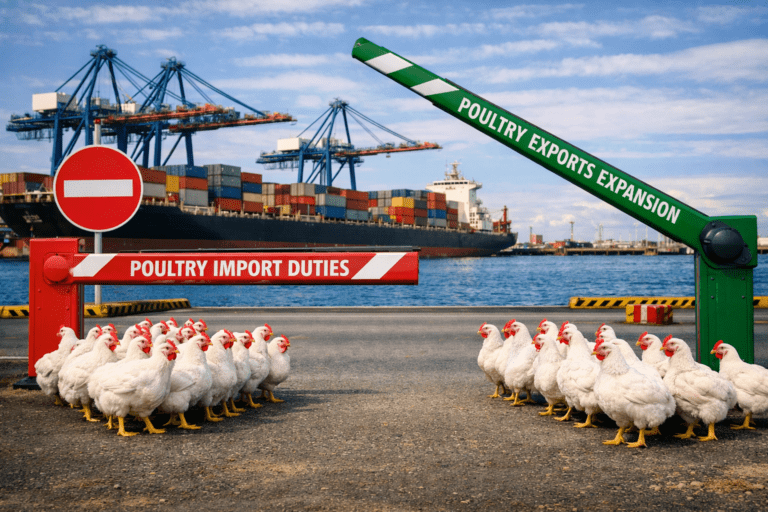
South Africa’s poultry industry is positioning itself as globally competitive and ready to expand into high value export markets.
Industry leaders argue that the sector has modernised, invested heavily and improved efficiencies to the point where exporting should be a natural next step. Yet the gap between ambition and reality remains wide.
In a recent webinar hosted by Fairplay, SAPA’s Izaak Breitenbach noted that the domestic market is saturated. Consumption growth has slowed, household budgets are under pressure, and producers have already expanded capacity.
The industry has grown 26% since 2019, having invested R2.1 billion, but now needs external markets to absorb future growth.
Why South Africa struggles to export despite being globally competitive
The industry notes it is cost competitive, with production costs now lower than the US and EU, however several structural barriers continue to limit South Africa’s ability to access and sustain export markets.
Regulatory and veterinary constraints
Export markets require predictable, internationally recognised veterinary systems. South Africa’s fragmented provincial structures, slow certification processes and limited veterinary capacity undermine confidence. Exporters repeatedly emphasised the need for government‑to‑government engagement to unlock inspections for the UK, EU and Saudi Arabia.
Trade diplomacy and market access
Competitor countries invest heavily in trade diplomacy. South Africa’s efforts remain inconsistent. Exporters described the need for stronger support from government departments, particularly in securing inspections and negotiating access to priority markets.
South Africa’s compartmentalisation structure
Currently, South Africa designates each province as an individual export compartment, meaning that a bird flu outbreak anywhere within a province can suspend exports from the entire province. Exporters stressed the need to shorten compartments to a 30km radius, noting that current rules make continuity nearly impossible.
Hormones: a non‑starter in many export markets
Many of the high‑value markets South Africa hopes to access, including the EU, UK, Saudi Arabia, and the UAE, maintain strict bans on poultry produced with growth‑promoting hormones. These markets require hormone‑free certification as a baseline condition for entry.
If South Africa continues to permit hormone use domestically, exporters will face a dual challenge:
- Segregating hormone‑free production lines at scale
- Proving traceability and compliance to regulators who already view South Africa’s veterinary systems as inconsistent
This is not a theoretical barrier. The EU, for example, explicitly prohibits imports of poultry treated with hormonal growth promoters. The UK mirrors this requirement. Gulf markets, while more flexible on some SPS issues, also require hormone‑free certification for poultry imports.
How global hormone bans apply: raw vs cooked poultry
Countries that prohibit hormone‑treated poultry do so across all product categories, including:
- Raw meat
- Frozen meat
- Cooked or heat‑treated meat
- Processed products (nuggets, patties, deli meats)
This is because the prohibition is production‑based, not product‑based. If hormones were used at any stage of production, the product is not eligible, regardless of whether it is later cooked.
Examples of markets with full hormone bans:
- European Union
- United Kingdom
- Saudi Arabia
- United Arab Emirates
- Japan
- Singapore
- China
These markets require certification that poultry was never exposed to hormonal growth promoters.
Implication for South Africa: If hormones remain permitted domestically, South Africa must create fully segregated, audited, hormone‑free export lines. Without this, both raw and cooked exports will be blocked.
HPAI vaccination: a solution at home, a barrier abroad
Recently, the Department of Agriculture has taken steps to introduce avian influenza vaccination to stabilise domestic supply. While vaccination can reduce mortality and production losses, it creates a new export dilemma.
Most major importing regions including the EU, UK, US, and China either prohibit or severely restrict imports of poultry from vaccinated flocks. Their concern is that vaccination can mask circulating virus, complicating surveillance and raising biosecurity risks.
If South Africa adopts HPAI vaccination without simultaneously upgrading its surveillance, reporting and compartmentalisation systems to international standards, the consequences are predictable:
- Vaccinated poultry may become automatically ineligible for export
- Compartments may fail to meet the stringent monitoring requirements demanded by high‑value markets
- South Africa could be locked out of markets it has spent years trying to access
This is especially significant given that the industry is already struggling to secure inspections for the EU, UK and Saudi Arabia. Introducing vaccination without a world‑class surveillance regime could push those inspections even further out of reach.
Restrictions apply to both raw and cooked poultry
Most high‑value markets restrict imports from vaccinated flocks, regardless of whether the product is raw or cooked. This is because their concern is epidemiological: Vaccination can mask circulating virus, it complicates surveillance, and it increases the risk of undetected spread.
Markets that restrict or prohibit imports from vaccinated flocks:
- EU
- UK
- US
- Japan
- China
- South Korea
The domestic contradiction: export ambitions built on protected foundations
The industry’s export ambitions sit uncomfortably alongside its long-standing reliance on import protection.
For more than a decade, high tariffs, antidumping duties and safeguard measures have shielded the domestic market from meaningful competition. These protections have stabilised margins, enabled investment and supported the industry’s recovery.
One speaker highlighted the industry’s success in securing “anti‑dumping duties” as part of its growth story. This protection has undeniably contributed to the sector’s current strength.
But it also creates a policy contradiction. You cannot claim global competitiveness while depending on permanent insulation from global competition.
If South Africa wants access to foreign markets, it must also demonstrate openness at home.
Balanced trade requires reciprocity. Trading partners will not accept a model where South Africa aggressively pursues export access while maintaining evergreen barriers against imports.
Imports play a legitimate and necessary role in a healthy market:
- They discipline prices and prevent excessive concentration.
- They stabilise the market during supply shocks.
- They expand consumer choice, especially for lower income households.
- They strengthen food security by diversifying supply sources.
A trade regime that restricts imports indefinitely while demanding export access is not credible. It weakens South Africa’s negotiating position and undermines trust.
South Africa’s poultry sector has the potential to become a meaningful exporter. But it cannot do so while holding onto permanent protections at home. A mature, export ready industry is one that competes fairly both domestically and internationally.