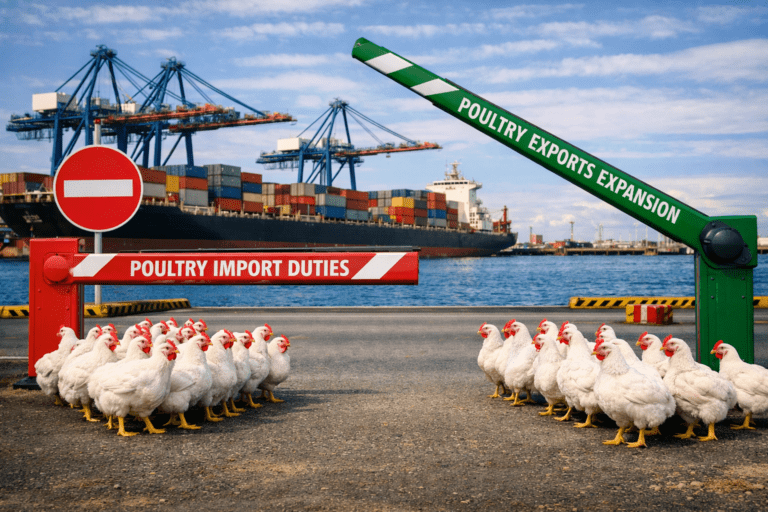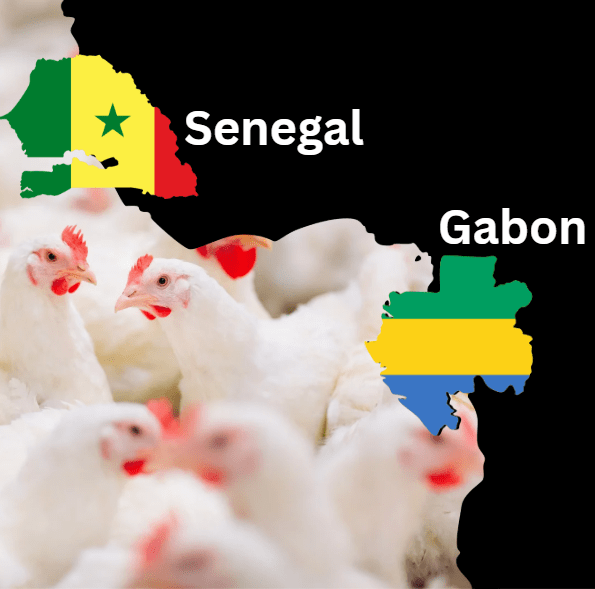
A recent special report celebrates Africa’s push toward domestic poultry production, with Gabon aiming to ban chicken imports by 2027 and following Senegal’s example in poultry self-sufficiency.
However, viewing import bans as a cure-all for food security ignores the immediate and often harsh consequences for consumer choice and affordability.
Imports are not a sign of weakness. They are a stabilising force in any modern food system. In Africa, they perform four essential functions:
- They keep prices competitive. For millions of low-income households, imported poultry is the only consistently affordable source of animal protein. There is no consumer benefit when a country bans imports.
- They cushion supply shocks. Outbreaks, droughts, and feed-price spikes routinely disrupt domestic production. Imports prevent empty shelves.
- They restrain price inflation. When competition disappears, prices rise. A chicken that is “local” but unaffordable does not advance food security.
- They offset high input costs. With feed accounting for up to 70% of production costs, domestic poultry will remain expensive until maize and soy become competitive.
This is the real tension: governments want sovereignty, but consumers need affordability.
Senegal: A Case Study in the Cost of Protectionism
Senegal’s 2005 import ban is often held up as a triumph of local industry. And yes, production has grown dramatically. But the consumer story tells a different truth.
Key realities:
- After nearly two decades of protection, chicken consumption remains structurally low, with little evidence that restricting supply does not automatically translate into accessible nutrition.
- Chicken is still a luxury. For most households, a whole bird is reserved for special occasions.
- Domestic chicken costs double imported leg quarters. High feed costs make local production structurally expensive.
- Smuggling fills the affordability gap. Many Senegalese consumers living near the borders regularly cross over to purchase more affordable, imported frozen chicken.
Gabon: Not a Ban — A State-managed Price Negotiation at Scale
Gabon is often lumped into the “import restriction” narrative, but the government is not banning imports; it is reorganising them. The Gabonese government’s primary strategy is the creation of the Centrale d’Achat du Gabon (CEAG).
What CEAG represents:
- A legal import monopoly for strategic goods, designed to negotiate lower global prices.
- A hybrid public–private model, with 63% ownership expected to remain with major local distributors.
- A single buyer system that replaces a fragmented import market, creating scale but also downward pressure on export prices.
This is not traditional protectionism it is state-managed import consolidation designed to extract better global pricing.
But the fundamentals remain unchanged:
- Gabon still relies on imports for food security.
- Domestic production is years away from meeting national demand.
- Affordability, not ideology, will determine whether households can access protein.
True food security is achieved when a market offers a stable supply of high-quality protein at a price that the lowest-income household can afford.
Removing Politics from Poultry
Africa’s poultry debate is too often framed as a battle between sovereignty and imports. In reality, consumers need both.
Domestic production is essential for long-term resilience, but imports are indispensable for short-term affordability.
Stable import frameworks also sustain long-term trade relationships that become critical when domestic supply is disrupted by disease outbreaks or climate shocks.
When policy focuses on protecting producers rather than lowering costs, the consumer loses, and the poorest lose first. You cannot regulate your way to food security if people cannot afford what is on the shelf.