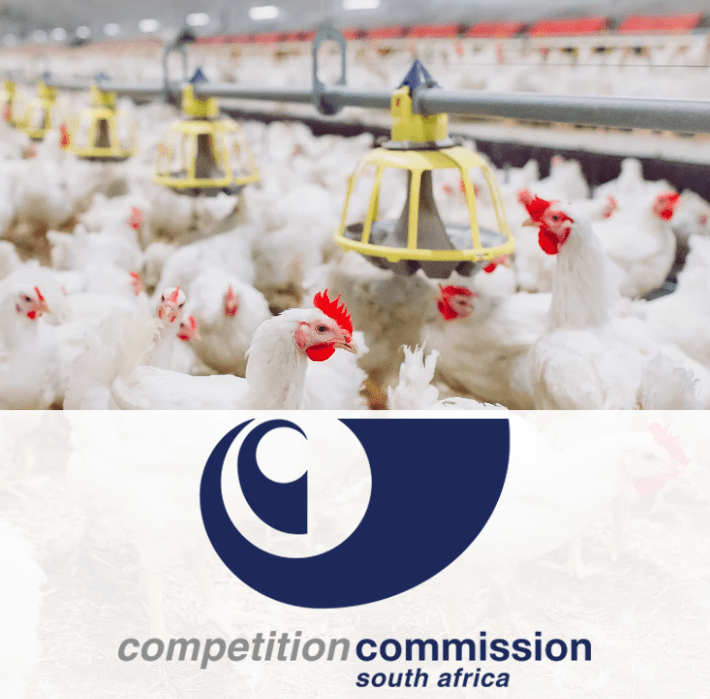
South Africa’s poultry market inquiry has technically advanced (mostly in gazettes and notices) while emerging farmers and consumers continue to wait for any real‑world impact.
The Competition Commission first signalled the inquiry in early 2024, after its 2023 review highlighted high concentration and structural barriers in the value chain.
The final terms of reference (ToR) were then gazetted on 30 September 2025, confirming the scope and timelines.
That is the most concrete development to date.
What Has Actually Moved
1.The scope is now formally set.
The ToR confirm that the inquiry will examine the entire poultry value chain: feed, genetics, day‑old chicks, contract growing, abattoirs, logistics, and retail.
The Commission’s concerns remain clear:
- High concentration and vertical integration
- Dependence on a few dominant firms for essential inputs
- Barriers to entry for SMEs and historically disadvantaged producers
These issues mirror the Commission’s earlier findings on structural distortions in the sector.
2.Timelines exist on paper.
The Commission must announce the inquiry’s formal commencement within 20 business days of the ToR being gazetted, after which it has 18 months to complete the process. If followed, this pushes the final report well into 2027.
3.Poultry remains a declared priority sector
The ToR reiterate poultry’s economic weight: the largest contributor to agricultural GDP and the country’s main source of meat protein. This is the Commission’s justification for deeper scrutiny.
What Has Not Happened and Why It Matters
Despite the formalities, there have been no public hearings, no interim findings, and no visible enforcement actions. The inquiry exists, but only administratively.
For emerging farmers, this silence is costly. The ToR acknowledge barriers to accessing feed, parent stock, day‑old chicks and abattoir capacity, yet nothing has shifted in practice.
Smaller producers remain price‑takers in a system dominated by vertically integrated firms.
For consumers, the stakes are equally high. The inquiry is supposed to test whether pricing reflects genuine cost pressures or market power. Until it moves beyond paperwork, households continue paying more for basic protein without clarity on why.
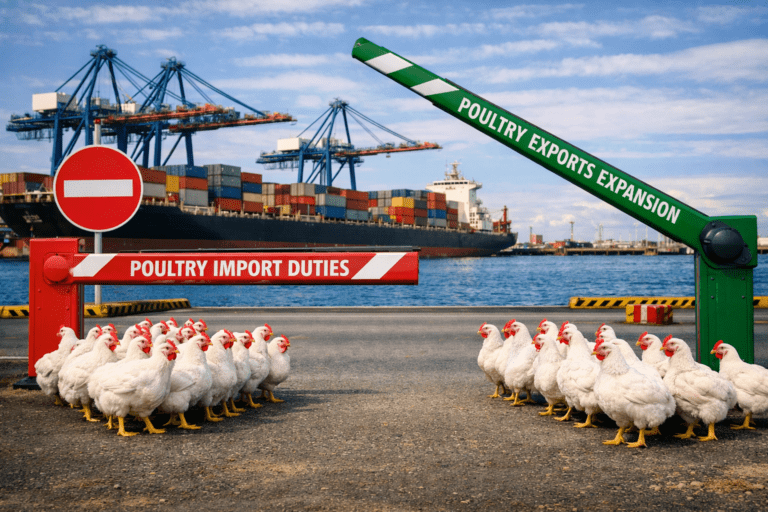
The inquiry should further evaluate whether import restrictions and increasing trade protection policies inadvertently strengthen domestic market concentration by reducing competitive pressures within the local market.
Why The Quiet?
With no progress announced to date, the central question is whether the inquiry will deliver substantive outcomes.
Will the inquiry receive the strategic prioritisation that government claims for the poultry sector? Can it effectively address the imbalance between export ambitions and ongoing import protectionism?
The final ToR are necessary, but they are not momentum. They simply confirm that the Commission understands the structural issues, not that it is addressing them.
These are the outcomes that must be achieved for meaningful progress:
- More transparent pricing throughout the value chain
- Easier access to abattoir and cold-chain infrastructure
- Fair access to feed and day-old chicks
- Expanded participation by SMEs and black-owned producers
- A balanced trade framework that protects both consumers and producers
- Greater market competition, avoiding further concentration
What Readers Should Watch Next
Three signals will show whether the inquiry is finally moving:
- A formal commencement notice with exact dates
- A public participation schedule that emerging farmers and consumer groups can realistically access
- Interim transparency. Even basic data releases on pricing, margins or market structure
The country’s poultry sector is too important to remain trapped between bureaucracy, concentration, and political rhetoric.
Until the inquiry moves beyond paperwork, emerging farmers will continue to be squeezed out of the market and South Africans will keep paying more for basic protein without clarity on why.
South Africa cannot discuss food security without discussing affordability. A concentrated poultry sector without meaningful competition risks turning the country’s most accessible protein into an increasingly expensive product for a nutritionally vulnerable population.
The success of the inquiry will ultimately be measured not by gazettes or timelines, but by whether it delivers a more competitive, transparent, and affordable protein market for consumers and emerging producers alike.