In a recent Freight News article, Francois Fouché, research fellow at the Centre for African Management and Markets at GIBS, shared his views on the persistent misunderstanding of imports in South Africa’s trade debate.
He argues that imports are not a threat to local industry but a fundamental part of economic growth.
ChickenFacts has consistently emphasised that South Africa’s food security, industrial competitiveness, and consumer welfare are fundamentally supported by a reliable and affordable supply of imports, with poultry playing a particularly crucial role.
Imports Are the Benefit, Not the Problem
Fouché notes that political narratives often celebrate exports as a victory while treating imports as a danger to jobs.
He reminds readers that exports are the work required to afford the goods a country needs, and that imports are the economic benefit.
ChickenFacts has consistently made the same point in the context of food production. South Africa cannot produce every input it needs at competitive prices.
In addition, risk factors such as disease outbreaks and climate change can significantly disrupt supply chains. By fostering a vibrant and robust imports and exports economy, South Africa is better positioned to mitigate these potential risks. Having more than one trading partner and multiple sourcing options increases resilience, ensuring that the country can adapt quickly to unforeseen challenges and maintain stability in essential sectors.
When policy treats imports as a threat, it ignores the reality that downstream industries rely on imported feed, equipment, vaccines, packaging, fertiliser and technology.
Restricting these inputs raises costs across the value chain and ultimately harms the very jobs policymakers aim to protect.
Tariffs That Protect A Few but Punish the Many
The Freight News article highlights the unintended consequences of heavy tariffs. Fouché warns that blocking cheaper imports to protect a small number of upstream manufacturing jobs forces downstream businesses to buy more expensive domestic inputs.
This slows growth, raises consumer prices and destroys more jobs than the tariffs preserve.
In same the way, tariffs on poultry imports increase the cost of protein, reduce competition, and ultimately place further financial pressure on millions of cash-strapped consumers.
Malnourishment and Growth Stunting in Children
An estimated one in four children under the age of five experience undernourishment and stunted growth.
In our 2026 State of the Nation Address, President Cyril Ramaphosa declared a “massive drive” to end child stunting and malnutrition in South Africa by 2030, labelling it a national crisis.
His plan prioritises the first 1,000 days of a child’s life, focusing on maternal nutrition, reducing alcohol consumption during pregnancy, and the affordability of protein-rich foods.
To this end, the introduction of VAT-free chicken or the lowering of tariffs on poultry imports could effectively address malnutrition among at-risk groups, while also fostering economic development and strengthening the competitiveness of domestic industries.
This makes it clear that policies aiming to restrict imports may threaten food security and the well-being of vulnerable communities, underscoring the need for careful consideration in policymaking.
Clarifying the Poultry Import Picture
The Freight News article states that South Africa is becoming more reliant on imported staples such as wheat, poultry and certain grains.
This is accurate for wheat and some grains, but the poultry picture is more complex.
South Africa’s reliance on bone-in chicken imports has declined sharply over the past six years due to anti-dumping duties and higher MFN tariffs.
SARS trade statistics show that bone-in imports dropped 83% from 224,198 tonnes in 2019 to 38,956 tonnes in 2024.
At the same time, reliance on other poultry import categories has increased, particularly mechanically de-boned meat (MDM) and offal.
Domestic production is insufficient to meet the demand for these poultry products, which have constituted the majority of South Africa’s imports in recent years:
- MDM accounted for 55% of all chicken imports in 2025, while offal made up 28%.
- The remaining imports consisted of bone-in cuts (14%), chicken carcasses (2%), and whole birds (1%).

Brazil continues to supply the majority of these imports, accounting for 85% of total poultry import volumes in 2025.
With Brazil being South Africa’s primary supplier, the absence of a regionalisation agreement means that a single outbreak can shut down the entire supply line, even if only one region is affected.
Summarily, South Africa is less reliant on imported bone-in chicken than historically, but still relies on imports for key poultry inputs that support affordability and supply stability.
The strategic value of these imports cannot be understated.
A Food System Exposed to Global Volatility
Fouché also highlights a contradiction in South Africa’s food trade profile. The country exports high-value agricultural products such as citrus and wine, yet increasingly imports foundational calories like wheat and certain proteins.
This creates vulnerability to exchange rate volatility and global supply chain shocks. A weaker currency raises the cost of imported feed, veterinary products, energy, and staple foods, quickly pushing up consumer prices.
A More Balanced Approach to Trade Policy
The Freight News article reinforces a point ChickenFacts has made for years. Imports are not a failure of the domestic industry. They are a sign of integration into the global economy and a prerequisite for competitiveness.
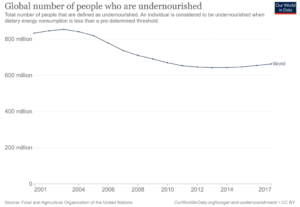
The World Economic Forum (WEF) demonstrates that the positive results of globalisation on GDP per capita growth and the reduction of extreme poverty are well documented.
The era of trade liberalisation not only produced better economic outcomes, but also reduced hunger and famine, and enhanced food security – all during a period of rapid population increase.
From 2001 to 2017, the number of undernourished people around the world plummeted by 170 million.
South Africa needs a trade policy that recognises the evident strategic value of imports, protects consumers, supports downstream industries, and strengthens food security.
A more balanced approach would treat imports as a tool for growth rather than a threat to be contained.