South Africa’s poultry industry is navigating a complex interplay of local production challenges, trade policies, and global market shifts.
Among the most influential players in this evolving landscape are Argentina and Brazil—two emerging markets that have significantly shaped South Africa’s poultry imports.
Their role in the industry is not just about supply and demand; it’s about economic strategy, food security, and the delicate balance between local production and international trade.
Brazil: The Powerhouse of Poultry Exports
Brazil has long been a dominant force in global poultry exports, and its influence on South Africa’s market is undeniable.
One of Brazil’s key advantages is its ability to maintain stable production despite global disruptions. While other major poultry-producing nations have struggled with outbreaks of highly pathogenic avian influenza (HPAI), Brazil has remained largely unaffected, allowing it to supply consistent volumes to import-dependent countries.
Supply consistency has made Brazil the go-to supplier for many African nations, including Libya, Egypt, Ghana, Angola, and Algeria.
In the last 12 months, Brazil accounted for 72% of South Africa’s total poultry imports, excluding mechanically de-boned meat (MDM).
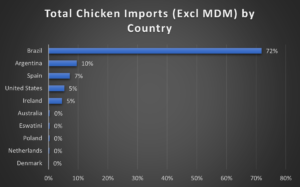
Source: SARS Trade Stats
Argentina: A Rising Contender in Poultry Trade
While Brazil has historically led South Africa’s poultry imports, Argentina has emerged as a noteworthy competitor.
Although its share of South Africa’s poultry imports is smaller—5.5% in 2021—Argentina’s role in the market is growing. The country’s poultry industry has been expanding rapidly, fuelled by high-quality production standards and a strong export strategy.
Argentina’s entry into South Africa’s poultry market has not been without challenges. In 2023, the country faced a six-month ban on poultry exports due to an outbreak of avian influenza.
However, once the ban was lifted, imports from Argentina surged, leading to concerns among local producers about market saturation.
The South African Poultry Association (SAPA) has even accused Argentina of “flooding” the South African market with cheap poultry imports, particularly mechanically de-boned meat (MDM) and offal.
Yet, a closer look at trade data reveals that Argentina’s poultry imports constitute only a small fraction of South Africa’s total supply, with MDM and offal making up just 4% of total imports.
Despite these concerns, Argentina’s poultry exports play a crucial role in South Africa’s food security.
MDM, for instance, is essential for producing processed meats like polony and viennas, which are staple protein sources for lower-income consumers. However, MDM is only marginally produced in South Africa because it is economically unfeasible to manufacture locally.
In comparison, even relatively affordable poultry, such as individually quick-frozen (IQF) chicken pieces (bone-in), is not considered economically feasible for South Africa’s lowest income earners.
Import Duties and the Decline of Bone-in Chicken Imports
South African poultry producers have long argued that the influx of Brazilian imports undermines local production, making it difficult for domestic businesses to compete.
SAPA has repeatedly called for stricter import regulations, citing concerns over unfair pricing and the impact on local jobs.
In 2020, the government raised the general Most-Favoured-Nation (MFN) duties on poultry imports to support local producers in expanding production and focusing on exports. The duty on bone-in poultry increased from 37% to 62%, while the duty on boneless poultry rose from 12% to 42%.
Since the introduction of general MFN duties in 2020, there has been a significant decline in bone-in chicken imports, which were once a major source of competition for local producers.
Looking at the latest trade statistics, imports of bone-in portions dropped by 83% from 224,198 tonnes in 2019 to 38,956 tonnes in 2024.

Source: SARS Trade Statistics
While this has provided relief to local producers, it has also created an artificial market dynamic where domestic suppliers face less competition.
This lack of competition has allowed local producers to dominate the market, potentially leading to higher prices and reduced consumer choice.
The Trade Policy Debate: Protectionism vs. Open Markets
South Africa’s approach to poultry imports has been a subject of heated debate.
On one side, local producers advocate for protectionist policies to shield domestic businesses from foreign competition. On the other, trade experts argue that open markets are essential for maintaining food security and price stability.
While imports from Brazil and Argentina provide consumers with affordable poultry options, they also pose a threat to local producers unable to compete with lower-cost imports.
The South African government has sought to strike a balance by imposing tariffs and anti-dumping duties on certain poultry imports. However, rather than fostering a genuinely competitive market, these measures have skewed the industry in favour of local producers, effectively granting them control over pricing without the pressure of meaningful competition.
This artificial market dynamic has raised concerns about affordability and fair market access, as domestic producers dictate prices without the balancing force of external market players.
Interestingly, Brazil has taken a different approach to trade policy. In an effort to control rising food prices, the country recently announced plans to reduce import duties on nine essential items, including poultry.
This move contrasts sharply with South Africa’s protectionist stance, raising questions about whether a more open trade policy could benefit the local market.
The Future of Poultry in South Africa
As South Africa continues to navigate the complexities of poultry trade, the role of emerging markets like Brazil and Argentina will remain pivotal.
While local producers push for greater protection, the reality is that imports are essential for maintaining food security and consumer affordability.
The challenge moving forward will be finding a sustainable balance—one that supports local production while leveraging the benefits of international trade.
However, the industry’s limited focus on the domestic market and neighbouring countries restricts its growth potential.
It is worth noting that the poultry industry’s reluctance to expand its trade opportunities beyond Africa highlights the fundamental solution to the contentious relationship between local producers and poultry imports.
This hesitation also contributes to the resulting imbalance and lack of healthy competition in the market.
Expanding into global markets would not only level the playing field but also introduce greater potential for market expansion, sustainability, and the development of emerging poultry producers.
While local producers appoint contract growers, there is still no material proof of emerging producers being developed into individual successful production capacity.
South Africa needs to establish a sustainable equilibrium between bolstering domestic production and capitalising on the advantages of international trade. Achieving this goal begins with the concerted development of emerging producers and improved policies that promote inclusive trade, market stability, competitiveness, and food security.