On 15 May, Brazil’s Ministry of Agriculture and Livestock (MAPA) officially confirmed the presence of highly pathogenic avian influenza (HPAI) in a commercial poultry farm in Montenegro, Rio Grande do Sul.
This marks the first recorded outbreak of HPAI within Brazil’s commercial poultry sector.
Regionalisation, otherwise known as zoning, would have allowed for imports from other parts of Brazil, except the regions affected by the outbreak.
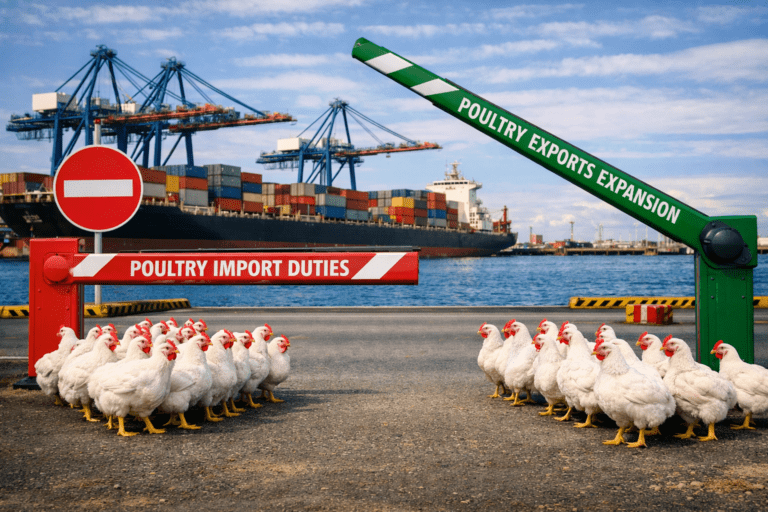
However, due to the absence of a zoning agreement between Brazil and South Africa, the Department of Agriculture has imposed a blanket ban on imports of all poultry products from Brazil.
The ban affects products packed on or after 01 May 2025. This follows Brazil’s Ministry of Agriculture confirming the start of an Avian Influenza event on 15 May 2025, with a 14-day incubation period according to the WOAH Terrestrial Animal Health Code.
Brazil plays a critical role in South Africa’s poultry supply chain, accounting for 92% of the country’s mechanically de-boned meat (MDM) imports—an average of 18,000 metric tonnes per month. It also supplies 73% of other poultry imports, including bone-in chicken and offals.
MDM is an essential ingredient in processed meat products such as polonies and sausages. South Africa lacks domestic commercial MDM production, making Brazil’s supply irreplaceable in the short term.
With no viable alternatives to replace MDM and offals in the South African market, the supply gap is expected to have severe repercussions for importers, poultry processors, retailers, and financially constrained consumers:
- Deficit of MDM and offals: Lack of access to affordable protein products such as polony, sausages, chicken feet, gizzards, livers, etc., which particularly affects South Africa’s most vulnerable low-income households.
- Production interruptions: Interruptions in local production of processed chicken products may potentially threaten several thousand jobs at poultry processing facilities across the nation.
- Economic impact: The absence of access to the MDM and offals product category has significant economic repercussions for South African importers, retailers, and informal traders.
- Price inflation and food security: Disruptions in MDM and poultry imports can lead to substantial price inflation, thereby increasing food insecurity.
Local Producers Claim They Can Close the Gap
The South African Poultry Association (SAPA) stated in a media release that local poultry producers have the capacity to compensate for the reduction in Brazilian chicken meat imports:
“We are currently producing about 21.5 million chickens per week, and the industry has the capacity to increase this by about another million birds per week. As the winter months are a period of lower demand for chicken, the additional supply should be sufficient to ensure there are no shortages of chicken meat, or price increases because of shortages.”
The validity of this statement has been called into question as South Africa’s largest poultry producer, Astral Foods, grapples with plummeting profit margins due to higher input costs.
Moreover, Daybreak Foods has been forced to cull over 350,000 birds amid reports of severe neglect and insufficient feeding at two of its poultry farms.
SAPA also acknowledges the expected shortfall of MDM supply from Brazil:
“If there is a problem following a ban on Brazilian imports, it will concern mechanically deboned meat (MDM), not fresh or frozen chicken meat. MDM is a paste used in the production of processed meats such as polony and sausages; it is not made in any large quantities in South Africa.”
Expected Poultry Shortfalls
Considering SAPA’s statement on the potential additional capacity of four million birds per month, a significant shortfall of various poultry cuts is still expected to impact the market.
According to SARS trade statistics, the current average import quantities from Brazil over the last few months are as follows:
| Cut Description | Average Metric Tonnes (Mt) Per Month |
| Chicken Feet | 4,000 |
| Gizzards | 1,500 |
| Livers | 500 |
| Necks | 500 |
| Chicken MDM | 18,000 |
Looking at the calculation on the estimated output from four million additional birds per month (using a standard broiler composition chart at 1.806 kg per chicken), the following shortfalls will remain:
| Cut Description | Metric Tonnes (Mt) Per Month | Estimated Shortfall (Mt) Per Month |
| Chicken Feet | 298 | -3,702 |
| Gizzards | 190 | -1,310 |
| Livers | 189 | -311 |
| Necks | 141 | -359 |
| Chicken MDM | 0 | -18,000 |
The other factor to consider is what’s known in the industry as “balancing the carcasses”. For example, each chicken only has two wings and two feet. Taking that in consideration, the importation of 4000 Mt of chicken feet would require an estimated 26 million chickens.

Job Losses & Trade Disruptions
An outright ban on Brazilian poultry imports would have severe economic repercussions, particularly in the food processing industry.
South Africa’s processed meat sector is heavily reliant on imported MDM, which is used in the production of polonies, sausages, and other processed meats. A supply shock in this category would risk thousands of manufacturing jobs, as local processors struggle to source alternative raw materials.
Beyond direct job losses, a shortfall in poultry imports could trigger a ripple effect across multiple industries, including retail, cold chain logistics, and distribution networks. Higher costs would ultimately burden consumers.
Disease outbreaks significantly alter global trade dynamics, often leading to prolonged disruptions and structural market changes:
- Import bans fragment established supply chains, forcing businesses to seek alternative sourcing partners, which may not always meet volume or cost requirements.
- The global poultry market shifts, as unaffected countries capitalise on temporary supply gaps.
- Governments often tighten import protocols, leading to longer administrative delays, even after the affected country regains disease-free status.
Without strategic interventions, rising production costs and import shortages could destabilise South Africa’s processed meat industry, leading to job losses, reduced product availability, and significant price increases for consumers.
Government Urged to Adopt a Regionalised Response to Avian Flu Outbreak in Brazil
Following confirmation of the outbreak in Rio Grande do Sul, the Association of Meat Importers and Exporters (AMIE) has urged the South African government to take a measured and collaborative approach.
Rather than imposing an indiscriminate ban on all Brazilian poultry imports, AMIE advocates for a regionalisation strategy, restricting imports only from affected regions.
This approach aligns with WOAH guidelines and has already been adopted by Japan, Saudi Arabia, the UAE, and the Philippines.
The absence of a regionalisation approach threatens South Africa’s most economically vulnerable consumers, particularly those in lower LSM groups who are already struggling with the rising cost of living.
Animal diseases remain a persistent challenge, making regionalisation the most effective path forward. Implementing regionalisation is not merely a trade strategy but a necessary intervention to shield the nation’s most at-risk consumers from the effects of supply chain disruptions.
ChickenFacts is closely tracking ongoing developments and will provide updates as they unfold.