It’s well-established that imported chicken often must meet tougher safety standards than that of locally produced alternatives.
Local producers have their own set of health and safety requirements including biosecurity, but the measures for imported meat is stricter to ensure possible contaminants or harmful products do not reach the consumer.
The Department of Agriculture, Land Reform and Rural Development (DALRRD) and its highly competent veterinary inspectors operate with the central objective of safeguarding South African consumers.
Upon arrival, all imported poultry products undergo stringent testing and verification before being released into the market.
Snapshot: Key distinctions between local and imported poultry safety regulations
Protocol Stage |
Local Poultry |
Imported Poultry |
| Farm Hygiene & Biosecurity | Ongoing throughout lifecycle | – |
| Vaccination & Disease Control | Mandatory local vaccine and test regimens | – |
| Slaughter Standards | SAPA-compliant abattoirs, monitored locally | – |
| Microbiological Testing | Not routine for all batches—done where needed | Mandatory—Lab tested for Aerobic counts, E. coli, Salmonella |
| Cold Chain Enforcement | Continuously maintained from farm onward | Checked upon arrival in SA—Strict temperature control for frozen and chilled product |
| Response to Contamination | Recall or suspension per SAPA protocols | Reject, destroy, or return shipment |
Imported Poultry Protocol
1. Scientific Testing for Harmful Bacteria
Consignments of imported chicken undergo microbiological testing at cold storage facilities. These tests look for:
- Salmonella (especially dangerous strains like S. typhi, S. enteritidis, and S. typhimurium).
- E. coli – which indicates hygiene standards.
- Overall bacterial load to assess freshness and handling quality.
If any of the dangerous strains are detected, the entire batch is either returned to the exporting country or safely destroyed.
2. Who Does the Testing?
The Border Management Authority (BMA) uses exclusively certified veterinary inspectors for the collection of samples.
3. Cold Chain Protection
Temperature checks are strict. Frozen samples must stay below 4°C (or 7°C for chilled products) from the moment of sampling to final delivery at the lab.
Even slight signs of thawing or temperature fluctuations trigger additional testing.
4. Sampling Standards
Inspectors randomly pick 5 boxes for sampling from each shipment.
Samples are tested in government-approved laboratories using internationally recognised methods.
5. Only the Safest Make It
Chicken that passes all tests is approved for human consumption.
If the bacterial levels are high (but not dangerous), it may still be allowed — but only after being heat-treated under veterinary supervision.
What Happens to Unsafe Meat?
Unsafe consignments are returned to the country of origin or destroyed at approved facilities. The supplier may be delisted from future exports to South Africa.
Imported Poultry Safety Flow Chart
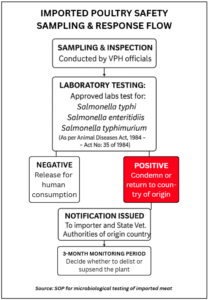
Source: PROCEDURE MANUAL: MICROBIOLOGICAL MONITORING OF IMPORTED MEAT (Department of Agriculture)
Local Poultry Protocols
South African poultry producers follow the South African Poultry Association Code of Practice (SAPA COP), which outlines safety at production level:
- Biosecurity and farm hygiene
- Vaccination and disease monitoring
- Transport standards
- Slaughter and processing standards
Routine microbiological testing is not required for all batches before reaching consumers. Instead, safety relies on compliance with farm-level controls and inspections at abattoirs regulated by the Meat Safety Act and SAPA COP.
Conclusion
From dock to dish, South Africa’s import protocols reflect a robust, science-driven commitment to consumer protection.
While local producers uphold farm-level biosecurity and SAPA standards, imported chicken is subject to additional safeguards—rigorous lab testing, temperature-controlled sampling, and government oversight at every stage.
South Africa’s Department of Agriculture works meticulously to ensure that only poultry which meets international safety standards and passes stringent checks reaches South African homes.