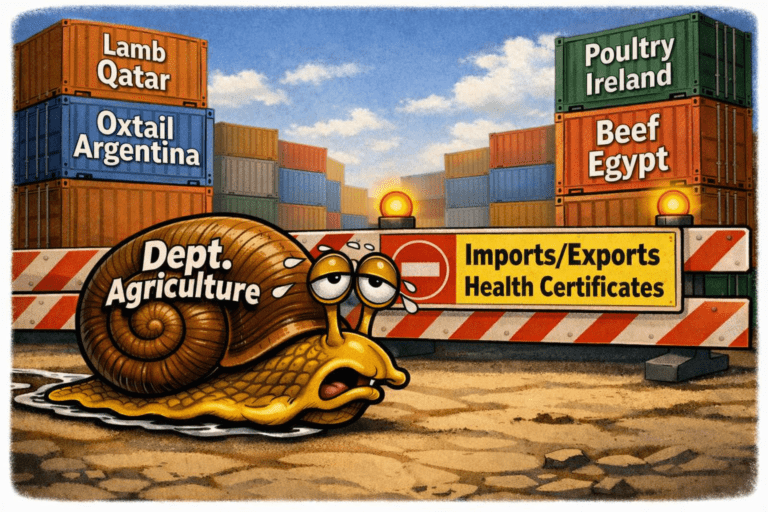
South Africa’s red meat sector is losing significant export revenue, domestic market stability and consumer affordability. It is also losing global competitiveness, foreign exchange earnings and critical rural economic opportunities as competing exporting nations move faster and more efficiently into international markets.
This is not because of disease outbreaks or global conditions, but because of regulatory paralysis inside DALRRD’s animal health and state veterinary systems.
Exporters and importers describe the same pattern across multiple markets: delays, silence, contradictory instructions and unexplained technical barriers.
The result is a system that actively blocks trade instead of enabling it. This is no longer simply an industry frustration. It is a governance and execution failure within the regulatory system responsible for facilitating agricultural trade.
Export Markets Are Open, but South Africa Isn’t Responding
Several countries, including the UAE and Jordan, accepted South Africa’s proposed health conditions months ago. Yet approvals were only finalised four months later.
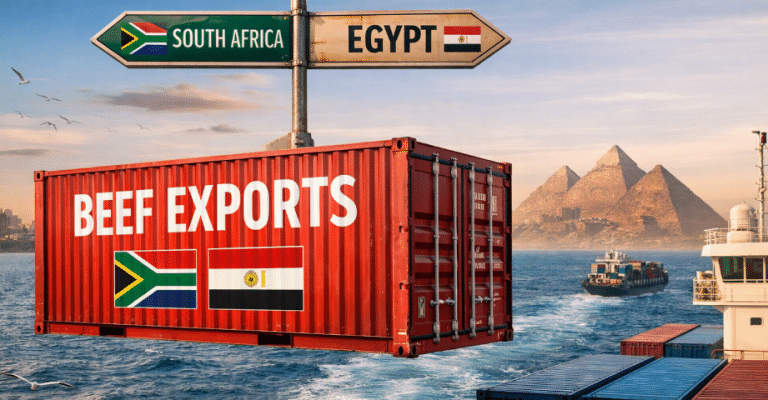
In other cases, such as Egypt, foreign authorities have sent the required documentation, but DALRRD has repeatedly claimed the correspondence was “not received”.
Embassies attempting to intervene have been told that only government-to-government communication is permitted. The problem is that government-level communication is not happening, according to Egypt.
This has created a backlog where one unresolved market (Egypt) is now blocking progress on Qatar, Mauritius and Bahrain.
Once export markets are lost or delayed, they are exceptionally difficult to recover as competitor countries rapidly move in to replace South African product.
Qatar: A R750 Million Annual Loss
Qatar banned South African lamb imports on 1 June 2024. Over a year later, the renegotiation remains incomplete.
Qatar customers have indicated they are ready to resume purchasing South African lamb, but South Africa has not finalised the paperwork. The financial impact is severe:
- 300 tonnes of lamb per month previously exported
- 250 000 lamb carcasses that would have earned export premiums
- ≈ R750 million lost per year
- ≈ R1.5 billion lost over two years
These exports would have generated valuable foreign exchange earnings for South Africa while supporting producers, abattoirs, logistics providers, and rural employment throughout the value chain.
Provincial Vets Apply National Rules Differently
The Association for Meat Importers and Exporters (AMIE) and industry stakeholders have repeatedly attempted to engage constructively with the Department through meetings, technical submissions, and direct correspondence.
Despite these efforts, critical trade matters continue to remain unresolved for extended periods with limited communication or feedback.
Even when permits are approved, implementation collapses. Provincial veterinary offices interpret national documents differently, resulting in rejected consignments, spoilage and financial losses.
This inconsistency undermines South Africa’s credibility and disrupts supply chains.
Oxtail Shortage: A Winter Crisis Created by a Permit Error
The dysfunction extends to imports, with direct consequences for South African households.
Argentina supplies 70% of all oxtail consumed in South Africa. Since Argentina recently reported a case of scrapie, an ovine (sheep) disease, Argentine veterinarians have subsequently stopped signing Health Certificates because the South African beef import permit incorrectly includes a clause relating to scrapie.
Argentina has formally requested that DALRRD remove the incorrect clause. Four weeks later, no action has been taken.
Impact on consumers and retailers:
- Estimated R100 million turnover losses expected over the winter period of June, July and August
- 1 000 tonnes of oxtail unavailable
- Retail prices have already jumped from around R80.00/kg to over R140.00/kg
- Importers are cancelling winter contracts
Meanwhile, Ireland has been open for trade since January 2026 and remains one of the few alternative sources of chicken and offal imports for South Africa. Yet, to date, the Department of Agriculture has still not reopened imports from Ireland.
Affordable protein remains a critical component of food security in South Africa. Administrative failures affecting meat imports are now directly impacting consumers and increasing the cost of basic food products during a period of severe economic pressure on households.
Why Can South Africa Export Fruit Efficiently but Not Meat?
The Department of Agriculture’s fruit export division is widely regarded as efficient and internationally competitive. The meat export division, by contrast, is described as non-communicative, slow and unwilling to engage.
Both divisions operate under the same ministry. Only one is functioning.
South Africa already has proof that efficient agricultural export systems are achievable. The continued dysfunction within meat exports, therefore, cannot be explained by lack of capability, but rather by lack of execution and accountability.
The Cost to South Africa
Export failures reduce farmer income and suppress investment. Producers cannot confidently expand herds, invest in infrastructure or employ additional workers if export market access remains unstable and unpredictable.
Import failures raise prices and restrict access to affordable protein. In both directions, the outcome is the same: Consumers pay more for less food.
South Africa’s meat industry is not asking the government for protection or financial support. It is asking for a functional regulatory system that communicates, processes approvals efficiently and applies technical rules consistently.
South Africa has world-class farmers, processors, exporters and cold chain infrastructure capable of competing globally. What is currently preventing growth is not lack of demand, production capacity or market opportunity, it is administrative failure.
Until accountability and operational stability are restored within the veterinary regulatory system, South Africa will continue to lose export revenue, rural investment opportunities and affordable protein access for consumers.