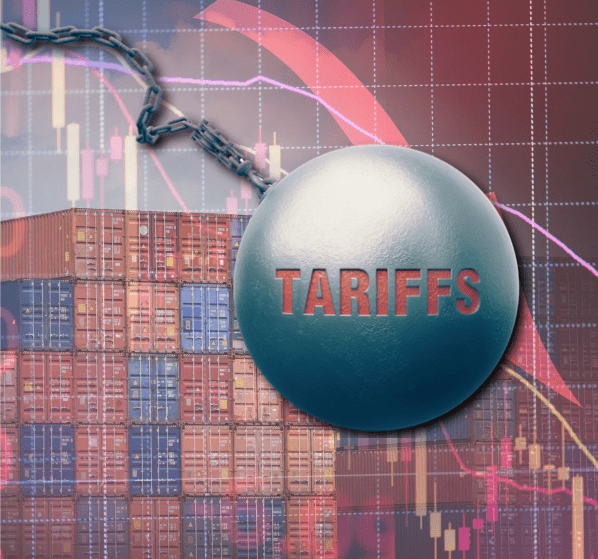
South Africa’s long‑standing reliance on heavy import tariffs is costing the economy far more than it protects. That is the central message from economist Francois Fouché, Research Associate at the Centre for African Markets and Management at GIBS Business School, who argues that protectionist policy has become a structural drag on growth, competitiveness, and consumer welfare.
Fouché says the country’s political rhetoric still treats exports as a “triumph” and imports as a “necessary evil”, a mindset he describes as outdated and economically damaging.
“Trade benefits an economy not because you get to send things away, but because you get to use those earnings from the exports to bring things in,” he explains. “The imports are in essence the economic benefits of the exports.”
Tariffs Protect a Few, While Punishing the Many
According to Fouché, heavy import tariffs imposed to “protect” domestic industries end up raising input costs for the entire downstream economy.
Using steel as an example, he notes that shielding a small number of jobs forces thousands of other businesses to buy more expensive local inputs, ultimately stifling growth and costing more jobs than the tariffs save. “It certainly does hurt consumers. And ultimately, it costs more jobs than what the tariffs would have saved.”
Fouché argues that South Africa’s protection regimes often lack sunset clauses, creating industries that never need to innovate. “Protection is all very well and good, but there needs to be an expiry date,” he says, warning that permanent protection breeds complacency rather than competitiveness.
Poultry: A Case Study in Misconceptions
The poultry sector offers a clear example of how tariffs distort markets and public understanding. Since 2018, South Africa has imposed heavy anti‑dumping duties and most‑favoured‑nation tariffs (sharply increased in 2020) on imported chicken. As a result, poultry imports have fallen from 24% of consumption in 2018 to around 16% in 2024.
Yet the data shows that imports are not undermining local production. SARS figures indicate that mechanically deboned meat (MDM), a key input for processed meats, made up 55% of all chicken imports in 2025, while bone‑in portions, which local producers specialise in, accounted for only 15%.
Local poultry output has grown 12% over the last decade, signalling a strengthening industry rather than one under threat.
Fouché stresses that imports are not the enemy: “It’s impossible for a country to be part of a global trade system unless they both export and import. We should focus on making trade and not war.”
He adds that when South Africa imports manufactured goods, “we are buying their functional logistics, their functional electricity, their functional industrial policy”; a reminder that imports often reflect domestic inefficiencies rather than foreign unfairness.
A Food Security Paradox
Despite South Africa’s reputation for agricultural excellence, Fouché warns of a “creeping vulnerability” in the national food basket. The country exports high‑value luxury crops like citrus and wine, yet increasingly imports foundational calories such as wheat, grains, and poultry.
“South Africa is exporting luxury crops to the wealthy world, but increasingly importing basic staples for our own population,” he notes. This makes food security hypersensitive to the exchange rate and global supply chain shocks.
The Balance‑of‑Payments Ceiling
Heavy tariffs also worsen South Africa’s long‑term growth constraint. Because the country does not manufacture enough of its own machinery, technology, or refined fuels, any economic upswing triggers a surge in imports, weakening the currency and forcing the Reserve Bank to raise interest rates. This cycle repeatedly “aborts” growth before it can lift incomes.
Fouché calls this the balance‑of‑payments ceiling: “Any economic boom requires a massive surge in imports to fuel that boom… and buying all those foreign goods drains foreign exchange reserves and weakens our currency.”
The only solution, he argues, is to rebuild South Africa’s industrial base and produce a wider variety of goods domestically — not through protectionism, but through competitiveness, infrastructure investment, and structural reform.
Time to Judge Policies by Results
Fouché closes with a warning drawn from Milton Friedman:
“One of the great mistakes is to judge policies and programmes by their intentions rather than their results.”
South Africa’s tariff‑heavy industrial policy may have been well‑intentioned, but decades later, the results are clear: higher costs, weaker competitiveness, slower growth, and greater vulnerability.
For the poultry sector and the broader economy, the path forward is not more protection, but more openness, more efficiency, and more ambition to compete globally.
For consumers, that would mean more affordable chicken and processed foods, greater product choice, and less pressure on household budgets already strained by inflation.
Listen to the Podcast
GIBS Research Associate and Economist, Francois Fouche, explains how heavy tariffs are hurting economic growth in SA, and what needs to happen to address the zero-sum cycle.