South Africa’s poultry sector is often described as robust and increasingly competitive, yet the national conversation around imports remains clouded by oversimplification.
Recent commentary has highlighted that imported poultry accounts for roughly 20% of annual consumption. This figure is frequently used to imply that South Africa is overly dependent on foreign suppliers or that imports undermine local production. The reality is far more complex.
Imports are not a sign of weakness. They are a structural necessity that supports food security, stabilises prices, fills supply gaps, and ensures that South Africans across all income levels have access to affordable protein.
Far from threatening the domestic industry, poultry imports play a complementary role that strengthens the entire value chain.
To understand why, one must look beyond macroeconomic trade figures and examine the biological and consumer realities that shape the poultry market.
The Carcass Balancing Problem That No One Talks About
While high-level trade commentary often focuses on aggregate import volumes, it misses the heartbeat of the poultry industry’s internal struggle: the carcass balancing act.
South Africans overwhelmingly prefer dark meat. Thighs, drumsticks, and wings dominate household demand. A chicken, however, only has two of each. To meet the country’s appetite for IQF portions, which retailers frequently use as loss leaders to attract shoppers, producers must process far more birds than the demand for white meat can absorb. This creates a surplus of breasts that must be sold at a premium to balance the economics of the entire bird.
Imports help correct this imbalance by supplying the products that South Africa consumes most, while allowing local producers to focus on the cuts they can sell at higher value.
Without imports, the domestic market would face chronic shortages of dark meat and persistent surpluses of white meat, which would distort pricing and undermine industry stability.
What South Africa Actually Imports
The narrative of excessive imports often assumes that South Africa is flooded with whole birds or prime cuts. In reality, more than half of all poultry imports consist of products that the country does not produce in sufficient quantities.
The import profile includes:
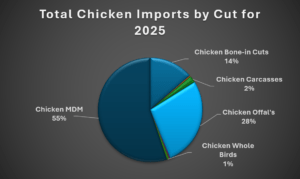
- Mechanically deboned meat (MDM), which made up more than half of all poultry imports in the first half of 2025. MDM is not commercially produced at scale in South Africa and is essential for manufacturing affordable processed meats such as polony and viennas.
- Offals, including chicken feet, heads, livers, and gizzards, which are in high demand among lower-income households and informal traders.
- Specific cuts that are not produced in the volumes required to meet domestic consumption patterns.
MDM is the lifeblood of the local processed meat industry. Without it, the manufacturing sector that sustains hundreds of thousands of jobs would face collapse.
For millions of South Africans, MDM-based products represent the most affordable and accessible source of protein. Local production cannot replace this supply at the required scale or cost.
The 2025 Brazil Import Disruption: A Case Study in Why Imports Matter
Brazil is South Africa’s largest poultry supplier. When Brazil experienced an HPAI outbreak in 2025, South Africa imposed a temporary ban. For six to eight weeks, no poultry shipments arrived.
The result was immediate:
- A sharp increase in import volumes once the ban was lifted, as importers scrambled to restore supply.
- Supply pressure in the processed meat sector due to the absence of MDM.
- Rising prices for offals and low-cost protein products.
- Strain on informal traders and low-income households.
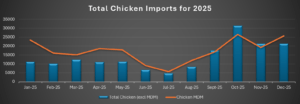
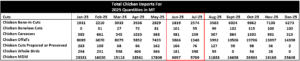
SARS trade statistics show that chicken imports declined sharply in June and July 2025 following Brazil’s closure due to the HPAI outbreak in May 2025, which significantly disrupted supply.
Import volumes fell well below the 2025 monthly averages, particularly for both total chicken imports (excluding MDM) and mechanically deboned meat (MDM).
However, import volumes began to recover as markets reopened, indicating that the earlier declines were largely driven by the temporary loss of Brazilian supply.
Based on the 2025 monthly average import volumes, total chicken imports (excluding MDM) averaged 13,919 metric tons (Mt) per month, while Mechanically Deboned Meat (MDM) imports averaged 17,121 Mt per month.
- June 2025: Compared with the monthly average, total chicken imports (excluding MDM) declined by 52%, representing a reduction of 7,305 Mt per month. Over the same period, MDM imports decreased by 47%, equivalent to 8,064 Mt per month.
- July 2025: The decline intensified, with total chicken imports (excluding MDM) falling by 66%, or 9,209 Mt below the monthly average. MDM imports declined by 67%, representing a reduction of 11,413 Mt.
This disruption demonstrated that without diversified and reliable import channels, South Africa’s food security becomes vulnerable.
The absence of a regionalisation agreement with Brazil means that a single outbreak can shut down the entire supply line, even if only one region is affected.
Why Poultry Imports Are Necessary
- Market Competition and Consumer Protection
Imports help maintain fair pricing. Without them, the domestic market risks becoming insulated from competitive pressure, leading to higher prices for consumers.
Competition also drives innovation and efficiency, which are essential for South Africa’s ambitions to expand poultry exports.
South Africa is already one of the most competitive producers globally, but the industry’s export footprint remains limited. Expanding into international markets requires a dynamic, competitive domestic environment that imports help to sustain.
- Diversification and Risk Mitigation
Imports from multiple regions reduce these risks and ensure supply continuity. Relying solely on domestic production exposes the country to:
- Disease outbreaks
- Feed price volatility
- Localised production shocks
- Supply chain disruptions
- Food Security and Affordability
Imports play a critical role in ensuring that all South Africans have access to affordable protein. This is especially true for:
- MDM, which is essential for processed meats
- Offals, which are widely consumed and culturally significant
- Low-cost cuts that support household food budgets
- Protecting Jobs in the Processing Sector
The local processed meat industry depends heavily on imported MDM. Without it:
- Production lines would halt
- Thousands of jobs would be at risk
- Retailers and informal traders would face shortages
- Prices of staple processed meats would surge
The Risks of Restricting Imports
Industry lobbyists have increasingly targeted the remaining import categories, particularly MDM and offals. Restricting these products would have severe consequences:
- Deficit of essential inputs for processed meat manufacturing
- Job losses in processing facilities
- Economic strain on importers, retailers, and informal traders
- Price inflation that disproportionately affects low-income households
- Reduced protein access for millions of South Africans
The Missing Piece: Exports
The Poultry Sector Master Plan has been highly effective at securing government protection through tariffs and anti-dumping duties. It has been far less aggressive in solving the other side of the equation: exports.
To truly balance the carcass, South African producers need access to markets that value premium white meat, such as the EU or the Middle East. Without strong export channels, the domestic industry remains trapped in a cycle of protectionism and internal price pressure.
Feed costs have declined due to record soybean and maize harvests, making South African farmers among the most competitive globally. Yet no amount of farming efficiency can change the fact that a chicken produces more white meat than the local market consumes.
Until the industry shifts its focus from raising trade barriers to opening export doors, imports will remain a misunderstood necessity rather than a sign of domestic failure.
Protein Security and the Impact of Tariffs
In 2020, South Africa raised Most Favoured Nation duties on poultry imports to support local producers. While this helped expand domestic production, it also increased consumer prices and reduced access to affordable protein.
Balancing protection with affordability is essential. Overprotection risks creating a monopolised market that harms consumers and undermines food security.
Building a Balanced and Sustainable Poultry Sector
South Africa requires both robust local production and well-planned imports to ensure a sustainable poultry sector.
Achieving this balance calls for an approach that expands exports to diversify revenue, invests in infrastructure and technology, and strengthens biosecurity while accelerating vaccine approvals.
It is also essential to support small-scale farmers and optimise trade policy so that crucial imports remain accessible. By implementing these strategies, the industry can build resilience and promote food security, providing affordable protein to millions and fostering a competitive market.
The question is not whether local producers can meet demand. The question is whether South Africa can afford a market without competition, diversity, and resilience.
Poultry imports are not a threat to South Africa’s agricultural sector. They are a vital component of a balanced, secure, and affordable food system. Imports ensure that consumers have access to affordable protein, that processors have the inputs they need, and that the market remains competitive and resilient.
A robust poultry sector requires the integration of local production with global trade. South Africa should not regard imports as an obstacle; instead, they constitute a vital component in addressing sector challenges.