South Africa’s trade landscape is evolving rapidly, shaped by regional agreements, shifting global market dynamics, and the growing need for strategic positioning in the poultry sector.
With frameworks like the African Continental Free Trade Area (AfCFTA) and the Southern African Customs Union (SACU) offering new opportunities, businesses must navigate these agreements effectively to capitalise on emerging markets and mitigate risks.
The poultry industry, a cornerstone of South Africa’s agricultural sector, faces unique challenges and opportunities within this broader trade environment. Understanding how regional trade agreements impact poultry imports and exports is crucial for ensuring food security, market competitiveness, and sustainable growth.
Regional Trade Agreements: A Gateway to Growth
Trade agreements streamline commerce by reducing tariffs and regulatory barriers, fostering economic integration, and enhancing market access. South Africa’s participation in AfCFTA, the EU-SADC Economic Partnership Agreement, SACU, and AGOA (Africa Growth and Opportunity Act) presents significant opportunities for businesses looking to expand their reach.
AfCFTA: Strengthening Intra-African Trade
AfCFTA aims to create a unified African market by eliminating trade barriers and promoting economic collaboration. South Africa has already begun preferential trade under AfCFTA, allowing duty-free or reduced-duty exports to 12 African countries. However, logistical inefficiencies and regulatory disparities remain obstacles to full implementation.
Investing in modernised customs procedures, improved border efficiency, and enhanced transportation networks will be critical in unlocking AfCFTA’s potential. Addressing non-tariff barriers will also help small and medium-sized enterprises (SMEs) participate more actively in regional trade.
EU-SADC Economic Partnership Agreement
The EU-SADC Economic Partnership Agreement (EPA) is a trade agreement between the European Union (EU) and six Southern African Development Community (SADC) member states.
It facilitates trade liberalisation, granting duty-free and quota-free access to the EU market for Botswana, Lesotho, Mozambique, Namibia, and Eswatini, with South Africa benefiting from 98.7% tariff-free access under specific quotas. The agreement includes asymmetric provisions, allowing SADC countries to protect sensitive products and apply safeguards if EU imports grow too quickly.
The EPA enhances agricultural market access, improving trade terms for wine, sugar, fisheries products, flowers, and canned fruits, while the EU gains better access to wheat, barley, cheese, meat products, and butter.
It also includes provisions on social and environmental matters, ensuring trade supports long-term development. South Africa benefits from protection of its geographical indications (GIs) in the EU market, such as wines, teas, and certain meat products, and SADC countries can increase import duties if EU imports threaten domestic production.
Signed in June 2016 and provisionally entered into force in October 2016, the agreement faces challenges, including the administration of tariff rate quotas, safeguard measures on poultry imports, and automatic agricultural safeguards.
Effective implementation and addressing these challenges are crucial for maximising the benefits of the EU-SADC EPA and supporting sustainable development in the region.
SACU: A Strategic Trade Bloc
SACU, comprising South Africa, Botswana, Lesotho, Namibia, and Eswatini, facilitates trade within Southern Africa by maintaining a common external tariff structure. This agreement provides South African poultry exporters with preferential access to neighbouring markets, reducing costs and improving competitiveness.
However, border congestion and inefficient customs processes—particularly at key trade hubs like Beitbridge Border Post—continue to hinder trade efficiency. Streamlining these processes will be essential for maximising SACU benefits.
AGOA: Navigating US Trade Relations
AGOA grants South African exporters duty-free access to the US market for select goods. However, recent diplomatic tensions, such as the expulsion of South Africa’s ambassador to the US, highlight the fragility of this agreement.
The AGOA poultry quota, negotiated in 2016, refers to the duty-free access granted to U.S. poultry exports under the African Growth and Opportunity Act (AGOA), allowing bone-in chicken portions to enter South Africa without anti-dumping duties.
The U.S. is permitted to export up to 72,000 tons of frozen bone-in chicken to South Africa annually without anti-dumping duties. Outside of the quota, U.S. poultry imports face a 62% general tariff plus additional anti-dumping duties.
South African poultry producers argue that duty-free U.S. imports harm local businesses, leading to job losses. Despite concerns, U.S. poultry imports have declined in recent years due to persistent HPAI (Highly Pathogenic Avian Influenza] outbreaks and market shifts.
Losing AGOA preferences would subject certain exports to higher tariffs, reducing South Africa’s competitiveness against lower-cost producers.
To mitigate risks, South Africa must diversify its trade partnerships beyond AGOA, strengthen ties with BRICS nations, and expand market access within Africa.
Poultry Trade: Imports, Exports, and Market Dynamics
South Africa’s poultry industry is deeply intertwined with trade policies, import regulations, and market competition. While the industry faces challenges, global market gaps present opportunities for strategic expansion.
Export-Led Growth: Trading Beyond Conventional Partners
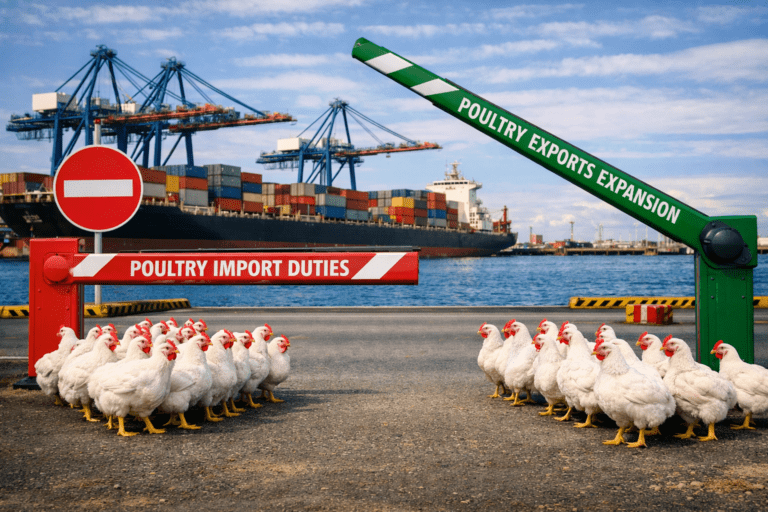
Industry leaders increasingly focus on export-led growth to counter domestic economic pressures and trade uncertainties. Expanding poultry exports to African markets under AfCFTA and leveraging SACU’s preferential trade conditions will be key to sustaining industry growth.
Agricultural and Agri-processing sectors hold unique advantages due to the country’s distinct growing cycles.
Rising income levels in Southeast Asian markets, for instance, are fuelling demand for South African products.
In a recent ChickenFacts article, international trade expert Dr. Martin Cameron projected an untapped market potential valued between $50 billion and $70 billion in countries including Germany, China, Japan, and India.
The key, however, lies in addressing logistical and regulatory barriers. “If infrastructure and services are not in place, political agreements become meaningless,” Dr. Cameron warned.
Market access also hinges on compliance with international standards, such as phytosanitary requirements, which require proactive government engagement.
It is worth noting that the poultry industry’s reluctance to expand its trade opportunities beyond Africa underscores the fundamental solution to the contentious relationship between local producers and poultry imports. This hesitation also contributes to the resulting imbalance and lack of healthy competition in the market.
Expanding into global markets would not only level the playing field, but also introduce greater potential for market expansion, sustainability, and the development of emerging poultry producers.
Addressing Supply Chain Disruptions
Global poultry markets have been impacted by Highly Pathogenic Avian Influenza (HPAI) outbreaks, rising feed costs, and logistical disruptions. South Africa can position itself as a reliable supplier by enhancing biosecurity measures, improving production efficiency, and investing in export-led growth.
HPAI remains an ongoing concern, with market outbreaks causing substantial disruptions in production.
The poultry industry has urgently appealed to the government to consider easing biosecurity protocols for approved AI vaccines to alleviate the impact of bird flu outbreaks.
With no government compensation for culling chicken flocks, farmers consider vaccination the only realistic solution to bird flu outbreaks.
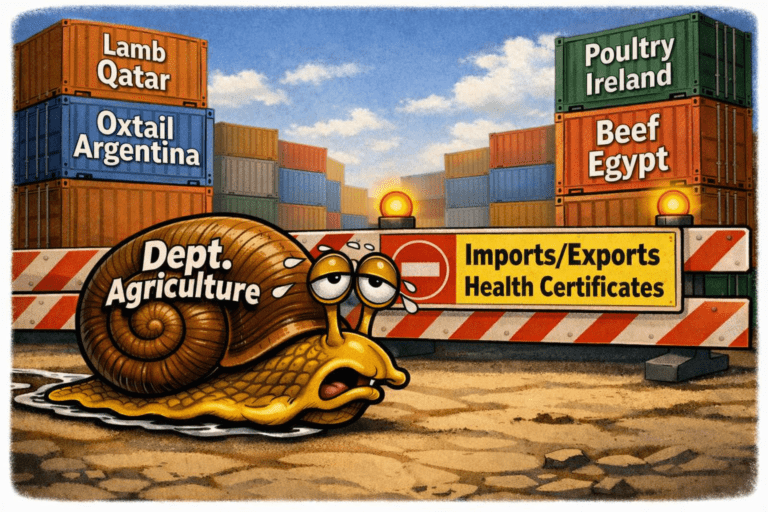
However, the vaccination rollout has encountered delays due to farmers’ inability to comply with the stringent biosecurity protocols set by the Department of Agriculture, Land Reform and Rural Development (DALRRD).
In response, DALRRD recently announced that it will hold discussions with poultry industry leaders to resolve the impasse hindering the commencement of a vaccination programme.
Poultry Imports
Imports play a crucial role in stabilising poultry prices and ensuring food security.
Mechanically Deboned Meat (MDM) is a crucial ingredient in the production of processed meats such as polony and viennas. Although MDM is produced only in limited quantities in South Africa, it plays a vital role in meeting the significant local demand for affordable processed meats.
Offal, including chicken heads, feet, livers, and other parts, constitutes a significant import that fulfils substantial local demand and affordability standards.
To achieve a sustainable balance between local production and imports, South Africa must address key challenges while leveraging the benefits of trade.
Investing in infrastructure, such as modernising facilities and providing access to advanced technology, can enhance production efficiency and capacity.
Promoting biosecurity by strengthening measures and expediting vaccine approval processes is critical to preventing disease outbreaks.
The implementation of fair-trade policies and the reduction of tariffs on essential imports can secure a consistent supply of affordable poultry. This approach will also help to balance South Africa’s poultry market, which currently favours domestic producers.
Disparity Between Red Meat Exports and Poultry
South Africa’s poultry industry is focused on increasing local production and expanding exports.
Looking at the latest trade statistics, chicken exports in the last 12 months totalled 58,045 tonnes, a 4% increase year-on-year (figures ending March 2025), with bone-in chicken being the leading poultry export commodity.
South Africa origin (produced in SA) chicken exports totalled 40,596 metric tons in the last 12 months (figures ending March 2025).

Source: SARS Trade Statistics
In January, SAPA reported progress in opening export markets. Residue monitoring programmes have been submitted, and inspections by the UK and Saudi Arabia are expected in the coming months.
These inspections are essential steps toward gaining access to the UK, the European Union (EU), and Saudi Arabian markets, with cooked chicken products, such as breast meat, being the primary focus.
According to SAPA, exports of uncooked chicken to these markets are not anticipated at this stage.
In sharp contrast to poultry, South Africa’s red meat industry, including beef and sheep meat, has shown resilience with beef production reaching 777,706 tons in 2024.
South Africa exported a total of 58 859 tonnes of beef by the last 12 month (figures ending March 2025). This was a significant increase of 27% compared to the 46 315 tons exported in the prior 12 months (Apr 23 – Mar 24). Major importing countries include Lesotho, Mozambique, Namibia, and the United Arab Emirates.
Additionally, South Africa exported 11 805 tons of sheep/lamb in over the same period, which was a 50% increase compared to the previous 12 months figures. The leading markets included Kuwait, Qatar, the United Arab Emirates, and Lesotho.
The increase in red meat exports can be attributed to improved biosecurity measures and collaborative efforts between the government and private industry to manage animal diseases and negotiate trade agreements.
Although red meat exports presently constitute only 5% of total production, emerging opportunities such as the recent entry into the Saudi Arabian market and ongoing negotiations with significant trade partners like China and Indonesia present substantial potential for growth.
Failing Policies and Strategy Insights
In 2020, the government raised the general Most-Favoured-Nation (MFN) duties on poultry imports to support local producers in expanding production and focusing on exports. The duty on bone-in poultry increased from 37% to 62%, while the duty on boneless poultry rose from 12% to 42%.
While these measures aim to protect local producers, higher tariffs often lead to increased chicken prices, reducing affordability for consumers who rely on affordable poultry as a staple protein source.
This lack of competition has allowed local producers to dominate the market, potentially leading to higher prices and reduced consumer choice. When local producers lack efficiency or cost competitiveness, import duties only create artificial protection rather than addressing underlying industry challenges. It also stifles innovation and the development of the local industry.
The Poultry Sector Master Plan, developed by the Department of Trade, Industry, and Competition (DTIC), aims to increase local production, expand exports, and improve consumer affordability.
Success has yet to be demonstrated. Progress made by the poultry industry in terms of transformation has been slow to emerge, and emerging farmers continue to lament their access to affordable feed and market access.
To adjust import tariffs is necessary to find a balance between protectionism and competition. This balance will benefit both producers and consumers by ensuring fair pricing, market stability and uninterrupted value chains.
Meanwhile, government funding for trade facilitation is limited as Treasury flounders to allocate resources effectively to foster economic growth.
For South Africa to remain competitive, a strategic policy approach is essential. Strengthening public-private partnerships, modernising digital customs processes, and enhancing regional trade networks will be critical in shaping South Africa’s economic future.
Main Trade Agreements between South Africa and the rest of the World


Conclusion
Notwithstanding its challenges, South Africa has a distinctive opportunity to reestablish itself as a leader in African trade.
By utilising regional agreements, improving trade infrastructure, and reforming trade policies, the nation can foster a more agile and resilient trade environment—one that strategically employs trade agreements to shape its economic future.