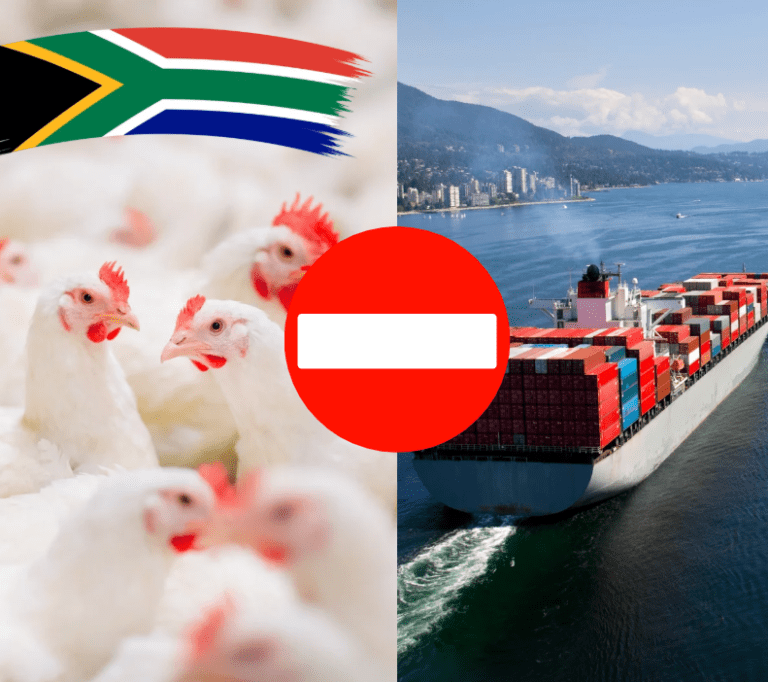
The industry welcomes the partial lifting of the import ban from Brazil, a decision announced earlier this week by the Department of Agriculture, bringing a sigh of relief to the poultry industry and consumers.
Effective June 19, 2025, poultry imports from Brazil will resume from all states except Rio Grande do Sul.
While the decision has averted major poultry shortages and potential job losses in the meat processing sector, industry has cautioned that short term shortages is still on the cards.
According to food producer, Eskort, mechanically deboned meat (MDM) supply will remain constricted for the next two months at minimum.
Brazil’s production of MDM requires a lead time of two weeks, followed by six weeks for shipping to South Africa, and up to two weeks for customs clearance.
Although Eskort says it has adequate stock, smaller suppliers are facing significant stock shortages. Consequently, ongoing impacts on overall food security are expected.
Imports: Business As Usual?
Not quite. The Department of Agriculture yesterday issued a notice that new applications for veterinary import permits (VIPs) must be submitted from 19 June 2025.
“Updated or new VIPs will be issued in line with the partial lifting of the ban.
VIPs issued before 19 May 2025 are cancelled and no longer valid for the importation of live poultry, poultry meat, and poultry products from Brazil—except heat-processed poultry products.”
Policy Reforms
The duration taken to lift the ban offers valuable lessons to be considered for fast-tracking biosecurity protocols in future crises.
South Africa has a history of taking six months to two years to lift trade bans on restricted countries. Ideally, these restrictions should be removed as soon as a country has been self-declared disease free.
The World Organisation for Animal Health (WOAH) emphasises that international trade should be based on scientific risk assessment and proportionate sanitary measures. WOAH advocates for the use of zoning, compartmentalisation, and specific risk mitigation to avoid unnecessary trade restrictions.
South Africa relies on poultry imports not only to meet domestic demand but also for job creation, economic diversification, and maintaining robust trade relations on the international stage.
The decision to regionalise Brazilian imports paves the way for proactive biosecurity policy reforms that mitigate food security risks in an age of ever-present disease epidemics.
Now is the time to find opportunity in adversity, to strengthen our policies, and forge a more economically resilient South Africa.
ChickenFacts will keep readers informed of new developments as they occur.