The African Continental Free Trade Area (AfCFTA) is one of the most ambitious trade agreements in history, aiming to create a single market for goods and services across Africa.
For poultry and meat importers/exporters, AfCFTA presents both unprecedented opportunities and significant challenges.
As implementation progresses, businesses must navigate evolving trade policies, infrastructure limitations, and market dynamics to maximise their benefits.
Understanding AfCFTA
AfCFTA was enforced by the African Union (AU) in May 2019. However, the implementation of its trade benefit was only initiated by South Africa on the 31st of January 2024.
AfCFTA was launched with the goal of eliminating tariffs on 90% of goods, facilitating free movement of people and capital, and boosting intra-African trade.
AfCFTA implementation consists of two phases:
- Phase one focuses on the movement of goods and five priority service sectors: financial services, communication, transport, tourism, and professional services.
- Phase two addresses investment, competition, intellectual property, and e-commerce development in Africa.
The agreement covers 55 African Union member states, making it the largest free trade area by number of participating countries.
South Africa, as a member of SACU (South African Customs Union), may enter into negotiations with other member states and trade blocs that ensure unique reciprocal benefits. Because SACU works off one communal tariff book, all negotiations must be with the other four members, namely Namibia, Lesotho, Eswatini, and Botswana.
For poultry and meat traders, AfCFTA promises expanded market access, reduced trade costs, and enhanced competitiveness.
However, successful implementation depends on overcoming logistical, regulatory, and infrastructural hurdles.
Progress So Far
Providing an update on work thus far, the Department of Agriculture recently stated that 54 African state parties have signed the agreement (excluding Eretria).
Of the 54, 48 have ratified AfCFTA and 49 have submitted tariff offers – category A covering 90% of the tariff book.
The 54 states are expected to submit their complete offers by October 2025, and all key instruments have been concluded for trade to commence.
Preferential Trade Agreements
Several African nations have begun duty-free or reduced-duty exports under AfCFTA.
Currently, besides SACU, the members listed AfCFTA preferential duty rates in their tariff schedules are Algeria, Cameroon, Egypt, Ghana, Kenya, Rwanda, Tunisia and Mauritius.
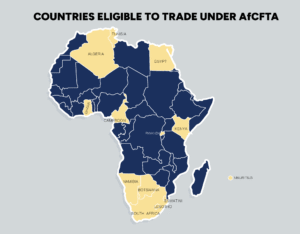
Source: https://importexportlicense.co.za/blog/afcfta/
Rules of Origin:
Currently, imports into SACU and exports from SACU enjoy tariff benefits only among specific AfCFTA members like Algeria, Ghana, and Kenya.
Negotiations are ongoing to expand this list, with 88% of tariff lines finalised, excluding the automotive and textile sectors.
Interim measures, including SADC certificates linked to AfCFTA registration, are in place until dedicated AfCFTA certificates of origin are available.
Guided Trade Initiative (GTI)
A pilot programme has tested AfCFTA’s provisions, allowing businesses to engage in cross-border trade under the agreement.
South Africa is part of the pilot programme known as the Guided Trade Initiative, which seeks to pilot implementation by evaluating the efficacy of the AfCFTA institutions, instruments, and systems.
South Africa launched trade with the first shipment destined for Ghana and Kenya in 2024.
Digital Customs & Payment Systems
Efforts are underway to streamline customs clearance and cross-border payments, reducing bureaucratic delays.
The AfCFTA Digital Protocol contains eleven sections covering broad areas such as market access, facilitating digital trade, data governance, business and consumer trust, digital trade inclusion, emerging technologies, transparency on government regulation, and capacity building.
Despite these advancements, full implementation remains a challenge, with regulatory disparities and logistical inefficiencies slowing progress.
Opportunities for Poultry & Meat Traders
Africa’s poultry market is valued at $15 billion, with significant growth anticipated in Ethiopia, Kenya, Ghana, South Africa, Rwanda, Uganda, Angola, Malawi, Senegal, and Cote d’Ivoire.
AfCFTA offers several key benefits for poultry and meat importers and exporters:
- Expanded Market Access: With tariff reductions, businesses can export poultry and meat products to new African markets at competitive prices. This is particularly beneficial for South African exporters, who can tap into West and East African demand.
- Reduced Trade Costs: Lower tariffs and streamlined customs procedures will cut costs for importers and exporters, making African-produced poultry and meat more affordable.
- Increased Investment & Infrastructure Development: AfCFTA encourages investment in cold storage, transport, and processing facilities, improving supply chain efficiency.
- Strengthened Regional Trade Partnerships: The agreement fosters collaboration between African nations, allowing poultry and meat traders to form strategic alliances and expand distribution networks.
Challenges to Overcome
While AfCFTA presents exciting prospects, several obstacles must be addressed:
Infrastructure Deficiencies: Many of the participating African countries lack adequate transport networks, cold storage, and processing facilities, making cross-border trade difficult.
Regulatory & Bureaucratic Barriers: Disparities in food safety standards, veterinary regulations, and customs procedures create trade bottlenecks. Harmonising these policies is essential for seamless trade.
Limited Awareness & Adoption: Many businesses remain unaware of AfCFTA’s benefits or struggle to navigate its complex trade protocols. Educational initiatives and government support are needed to bridge this gap.
Competition & Market Perception: African-made poultry and meat products often face stiff competition from imports outside the continent. Changing consumer perceptions and enhancing product quality will be crucial.
Conclusion
AfCFTA holds immense potential for poultry and meat importers/exporters, offering expanded market access, reduced trade costs, and investment opportunities. However, infrastructure gaps, regulatory barriers, and market competition must be addressed to fully realise its benefits.
For businesses in the poultry sector, strategic adaptation—including leveraging digital trade platforms, forming regional partnerships, and advocating for policy harmonisation—will be key to thriving under AfCFTA.
As implementation progresses, staying informed and proactive will ensure that poultry and meat traders capitalise on Africa’s evolving trade landscape.
ChickenFacts will continuously monitor developments and provide the latest information as it becomes available.