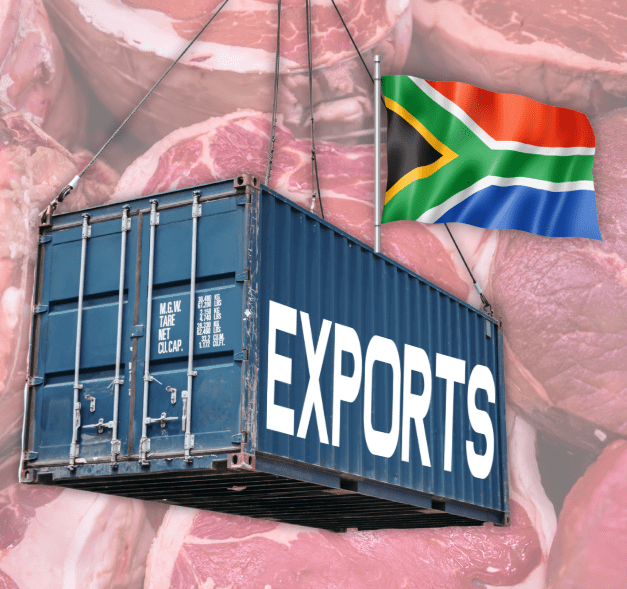
South Africa’s long‑awaited beef access to Egypt has progressed after the Department of Agriculture’s Import Export Policy Unit concluded the Veterinary Health Certificate (VHC) with Egyptian veterinary authorities.
The agreement was achieved through direct government‑to‑government engagement. Industry bodies such as the Association of Meat Importers and Exporters (AMIE) and the Red Meat Abattoir Association (RMAA) have supported market access efforts.
In accordance with the VHC, Egypt will accept meat from animals that were clinically healthy for 30 days before slaughter and at the time of slaughter. Meat from both vaccinated and unvaccinated animals may qualify, provided the relevant certificate conditions are met.
Beef Export Conditions Set Out in the VHC
| Area | Newly Confirmed in the VHC |
| Eligibility of vaccinated animals | Vaccination must be for SAT strains. Animals must be vaccinated at least once where vaccination is practiced. |
| Eligibility of unvaccinated animals | Farm must have no clinical FMD for three months and no vaccination history for six months. |
| Residency requirement | Animals must remain on a farm or feedlot for at least three months prior to slaughter. |
| 30‑day clinical freedom | Explicit requirement: animals must be kept for 30 days in an establishment with no clinical FMD. |
| Abattoir requirements | No FMD detected between last disinfection and shipment. Ante‑ and post‑mortem inspections within 24 hours before and after slaughter. |
| Processing requirements | Mandatory deboning, removal of head, feet, viscera and major lymph nodes. Maturation at more than 2°C for 24 hours. pH less than 6.0 in longissimus dorsi muscles. |
| RVF requirements | Animals must show no clinical signs within 24 hours before slaughter. Carcasses must undergo maturation. Meat must be protected from RVF contamination. |
| Certification authority | Only Provincial State Veterinarians may sign the certificate. |
What Egypt Has Agreed To
The VHC confirms that Egypt will accept boneless frozen or chilled beef from South Africa under clearly defined conditions. Key elements include:
- Meat must originate from animals slaughtered at South African Veterinary Authority export‑approved abattoirs.
- Animals must be clinically healthy at slaughter and must pass ante‑ and post‑mortem inspection.
- Meat from both vaccinated and unvaccinated animals is eligible, provided it meets the certificate requirements.
- Residues must comply with South African legislation and Codex guidelines.
- All establishments must operate HACCP‑based food safety systems.
The certificate confirms that South African beef can qualify for export to Egypt when cattle come from farms and facilities with appropriate disease controls and when the meat is handled in accordance with approved food-safety procedures.
In practical terms, producers and processors will need to show that animals were healthy before slaughter, that foot-and-mouth disease risks were properly managed, and that the beef was prepared and stored in a way that protects its safety.
These conditions will ultimately determine which abattoirs and processing plants are approved to supply the market.
Why This Market Matters
Egypt is one of the Middle East’s largest beef‑importing markets, with imports accounting for more than half of domestic consumption.
Access to this market could help South Africa recover from the sharp decline in beef exports caused by FMD‑related closures in 2025 and 2026.
The VHC provides a regulatory foundation that can support producers, processors and rural economies once operational.
What Needs to Happen Before Exports Can Begin
Although the VHC is finalised, exports cannot begin until several steps are completed:
- The VHC must be formally signed by both governments.
- Export abattoirs, cutting plants and cold stores must be approved under the certificate.
- Establishments must demonstrate compliance with the three‑month residency, 30‑day clinical freedom, vaccination records, maturation, pH testing and deboning requirements.
- Provincial State Veterinarians must be ready to certify consignments under the new conditions.
The release of the VHC is a major milestone for South Africa’s beef sector. It confirms that Egypt will accept meat from vaccinated animals and provides full technical conditions for export.
The reopening of Egypt, a major beef-importing market in the region, represents a positive achievement for South Africa’s beef sector and offers local producers a valuable opportunity to strengthen their credibility and rebuild momentum in the market. Realising this potential will depend on continued cooperation and support from the relevant authorities to facilitate the effective implementation of export processes.