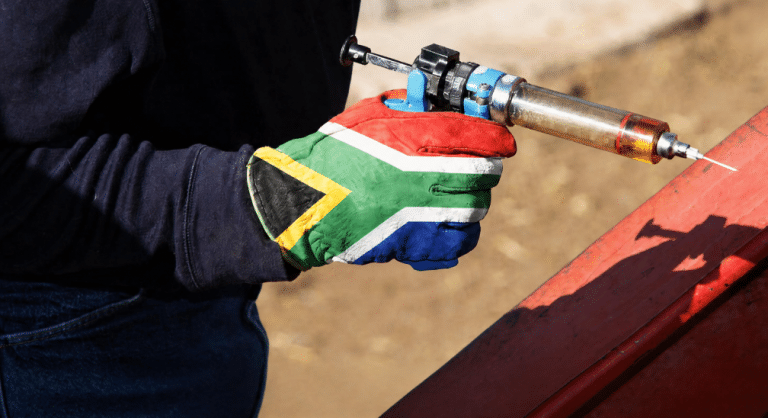
South Africa’s Foot and Mouth Disease (FMD) vaccination programme was launched in February to stabilise the livestock sector after two years of escalating outbreaks. The Department of Agriculture has described it as the largest FMD outbreak in the country’s history.
Eight months into the rollout, the situation remains volatile. Farmers report persistent infections, uneven access to vaccines, and growing distrust in the state’s crisis management.
Allegations of profiteering and failures in international diagnostic cooperation have further undermined confidence.
This investigation examines what is happening on the ground, whether vaccines are being used effectively, and why the national strategy is still struggling to contain the disease.
Vaccination Rollout: Progress on Paper
Government maintains that roughly 23 million doses have been imported and that more than a million dairy cows have been vaccinated at least once, with vaccinated herds showing improved stability. Official statements highlight better surveillance and early detection.
Farmers disagree. According to Business Day, producers accuse the state of poor coordination, slow distribution, and inconsistent communication. They argue that outbreaks continue to spread in several provinces despite the rollout.
The gap between official reporting and farmer experience is widening. While government attributes rising case numbers to improved detection, producers say the increase reflects ongoing transmission and delayed containment.
What Is Happening on the Ground with FMD Vaccines?
Although South Africa secured doses from Argentina (Biogénesis Bagó) and Turkey (Dollvet) early in 2026, distribution has been inconsistent. Commercial dairy regions received early allocations, but mixed-production and communal farming areas report shortages and delayed second-round vaccinations.
Producers in KwaZulu-Natal and the Free State report that movement restrictions are enforced unevenly, and illegal livestock movements continue to undermine containment efforts.
Farmers say they are not receiving clear timelines for booster vaccinations or transparent reporting on stock levels, fuelling suspicion that the programme is struggling to keep pace with the outbreak.
No International Vaccine Matching
The Agricultural Research Council’s Onderstepoort Veterinary Research Campus (ARC-OVR) is responsible for monitoring the FMD epidemic.
One of the most serious weaknesses in South Africa’s FMD response is the failure to send samples to the Pirbright Institute in the UK for vaccine matching. Pirbright is the global reference laboratory for FMD strain identification and vaccine suitability.
FMD viruses mutate rapidly. Vaccines must be matched to circulating strains to ensure effectiveness. Without international confirmation, South Africa cannot verify whether current vaccines are optimally matched.
Despite industry requests, samples have not been sent to Pirbright for strain confirmation since the first batch in January this year. This has left farmers and veterinarians uncertain about whether the vaccines being administered are fully effective against the strains circulating in 2026. The Agricultural Research Council maintains that its analysis of the January samples found “no significant antigenic or genetic drift” so far, though Pirbright’s own Q1 2026 report flagged “early evidence of antigenic diversity” in circulating strains.
It also raises questions about whether outbreaks persisting in vaccinated herds may be linked to mismatched strains rather than poor compliance.
Vaccine Profiteering Concerns
The vaccination rollout has been overshadowed by allegations of irregular pricing and possible profiteering.
On 5 September, Agriculture Minister Willie Aucamp suspended Dr Jacob Modumo, the acting CEO of Onderstepoort Biological Products (OBP), following allegations of irregular pricing linked to FMD vaccines. Aucamp said OBP “should not unduly profit from the tragedy of FMD currently facing our farmers,” but stressed that the suspension is precautionary and “should not be interpreted as a finding of wrongdoing or misconduct.”
The allegations suggest that OBP imported the vaccine from Biogénesis Bagó in Argentina at R45 per dose and resold it to farmers for between R70 and R130 per dose.
If Modumo fails to provide sufficient grounds against his suspension, an independent investigation will follow.
Meanwhile, farmers interviewed in the Business Day report described cases where vaccines were offered through informal channels at significantly higher prices. While unverified, these claims reflect widespread distrust and the perception that vaccine scarcity is enabling opportunistic behaviour.
Government has not released a full audit of vaccine procurement, pricing or distribution. Without disclosure, concerns about profiteering are likely to persist.
Is the FMD Crisis Under Control?
Government reports that vaccinated herds are stabilising and that surveillance improvements explain rising case numbers.
Producers argue that the situation is not under control. They cite ongoing outbreaks, slow vaccine delivery, weak movement controls, and limited communication.
Based on available evidence, the vaccination drive has achieved partial containment in commercial regions but has not stabilised the broader livestock sector. Key weaknesses include:
- Failure to send samples to Pirbright for vaccine matching
- Delayed distribution to high-risk communal areas
- Allegations of pricing irregularities
- Persistent outbreaks across multiple provinces
- Weak enforcement of movement controls
- Mistrust between farmers and government
The programme may not be failing, but it is not delivering full control.
What Needs to Happen Now
South Africa’s FMD vaccination drive has delivered early successes in some regions, but the broader crisis remains unstable.
An immediate priority is to submit samples to the Pirbright Institute for international confirmation that the vaccines being administered match the strains currently circulating.
Restoring trust will also require full transparency around vaccine procurement, pricing and distribution. A public audit of OBP’s processes would help address allegations of profiteering and clarify how doses are allocated.
At the same time, communal and mixed-production regions must receive vaccines as quickly and consistently as commercial dairy areas so that unequal access does not prolong transmission.
Stronger enforcement of livestock movement controls is equally important, as illegal movements remain a major driver of the disease’s spread.
Joint monitoring by government and industry, supported by independent oversight, could provide credible evidence of progress and help rebuild confidence among farmers and veterinarians.
Until vaccine matching is independently confirmed, distribution becomes more equitable, and procurement is disclosed more openly, the national response is unlikely to achieve industry trust and full control of the FMD crisis.