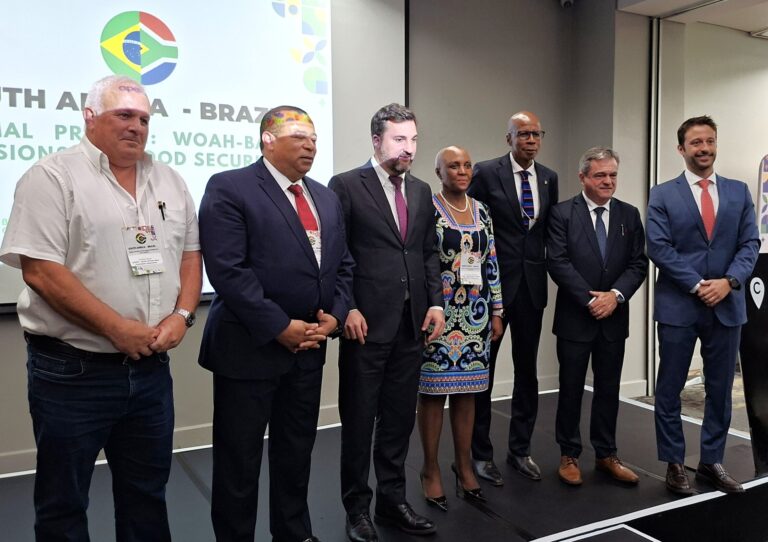
South Africa and Brazil deepened their agricultural partnership during a high-level seminar held in Pretoria on 10 December 2025. The event formed part of ABPA’s (Brazilian Association of Animal Protein) International Road Show and brought together senior government officials, veterinary experts and industry leaders to address shared challenges in protein security, animal health and trade stability.
The Brazilian delegation included Ambassador Benedicto Fonseca Filho, Deputy Minister Luis Rua from Brazil’s Ministry of Agriculture and Livestock, and Ricardo Santin, President of the Brazilian Association of Animal Protein (ABPA). South Africa was represented by Dr Mooketsa Ramasodi, Director General of the Department of Agriculture, along with senior veterinary authorities and import sector stakeholders.
Discussions focused on stabilising protein supply chains, improving veterinary cooperation and strengthening science-based trade systems. A key outcome was the emphasis on regionalisation, a World Organisation for Animal Health (WOAH) principle that allows trade to continue safely from unaffected zones during disease outbreaks. Brazil presented its rapid containment of avian influenza and its long-term success in eradicating foot-and-mouth disease as examples of how disciplined systems can protect both trade and food security.
Dr Ramasodi proposed establishing a formal South Africa-Brazil agricultural working group to advance cooperation on disease surveillance, science-based trade protocols, and regionalisation frameworks. This working group was positioned as a mechanism to institutionalise collaboration, reduce future supply shocks and align both countries with WOAH standards.
South Africa’s Protein Landscape
South Africa relies heavily on imported poultry and pork inputs to keep protein affordable. Mechanically deboned meat and offals are especially important for low-cost processed meats consumed daily by millions of households. Brazil remains the primary supplier of these inputs, supporting retailers, processors, school feeding programmes and the informal sector.
Any disruption to these imports has immediate consequences for affordability and availability.
Science-Based Trade Cooperation
The Pretoria seminar reinforced a shared commitment to science-based trade. Both countries highlighted the need for predictable, transparent systems that protect consumers without creating unnecessary barriers.
Key themes included regionalisation, traceability, digital certification, and coordinated public- and private-sector action. Brazil’s rapid containment of avian influenza and its long-term disease management systems were presented as practical models for South Africa.
Regionalisation and Trade Stability
South Africa has historically applied blanket import suspensions during disease events in exporting countries. This approach has repeatedly disrupted access to MDM and offals, even when outbreaks were isolated and fully contained.
One suspension removed an estimated 100 million meals per week from the South African food system. A bilateral regionalisation agreement would prevent such disruptions by allowing imports to continue safely from disease-free zones. This would protect both food security and price stability.
FMD in South Africa
South Africa’s livestock sector is under pressure from a worsening foot-and-mouth disease (FMD) crisis. New cases in the Free State have led to cattle culling and rising beef prices, adding strain to households already affected by food inflation.
South African leaders have acknowledged Brazil’s success in eradicating FMD through decades of investment in vaccination, movement control and coordinated action. Brazil’s model is now seen as a reference point for long-term stability.
Lessons From Brazil’s FMD Eradication
Brazil’s eradication strategy offers several insights for South Africa. These include proactive vaccination, strict movement permits, traceability systems and unified public and private sector coordination. Adopting similar systems could significantly improve outbreak control and restore confidence in South Africa’s livestock sector.
Food Security
Regionalisation is a critical safeguard for South Africa. By allowing imports to continue safely from disease-free zones, it protects access to MDM and offals that underpin the local production of affordable processed meats for low-income households. These products are primarily sourced from Brazil, and blanket suspensions immediately raise prices and reduce availability.
At the same time, South Africa’s own FMD crisis is pushing beef prices upward and threatening rural livelihoods. Brazil’s success in eradicating FMD demonstrates that long-term stability is achievable with coordinated action, proactive vaccination and strict movement control.
Strengthening regionalisation for imports and strengthening FMD management at home are two sides of the same strategy. Together, they ensure that South Africans who rely on affordable meat protein can continue to access safe, stable and affordable nutrition.