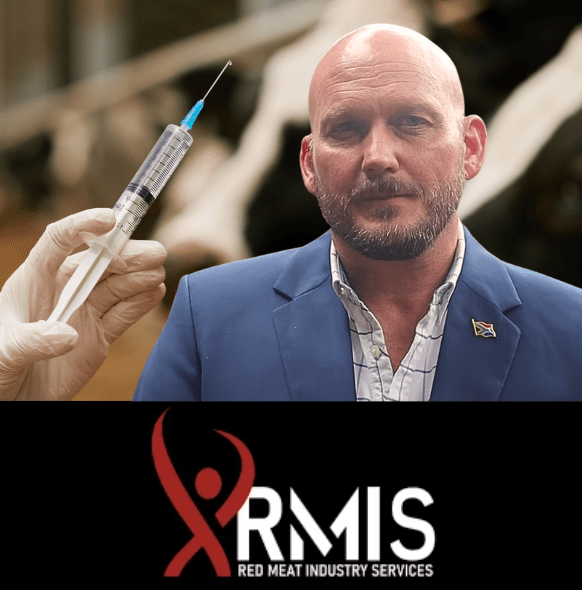
South Africa’s Foot and Mouth Disease crisis has moved beyond a temporary disruption. It is now a structural challenge affecting every part of the red meat value chain.
According to Dewald Olivier, CEO of Red Meat Industry Services (RMIS), the impact is “material and ongoing”, stretching from the farm gate to the consumer and reshaping the sector’s future.
This article uses Olivier’s insights as the foundation for understanding what is happening, why the system is under such pressure and what must change for South Africa to regain stability and export credibility.
It also builds on our recent analysis, South Africa’s Meat Export Crisis: Billions Lost as Government Fails to Act, which highlighted how regulatory failures have already cost the country significant market access.
FMD is disrupting the entire value chain
Olivier describes the current environment as one defined by uncertainty, financial strain and operational disruption.
Even where animals are clinically unaffected, the regulatory consequences of FMD create real economic damage. Producers face movement restrictions, disrupted marketing channels, increased biosecurity costs and delays in slaughter and sales, all of which erode confidence and cash flow.
At a sector level, FMD undermines export competitiveness and forces more product into the domestic market, compressing margins and destabilising pricing.
Consumers feel the downstream effects through supply disruptions, logistical inefficiencies and higher compliance costs that eventually translate into price volatility.
Olivier is clear that none of this has quick resolves. Until FMD is firmly under control through coordinated vaccination, traceability and surveillance, the sector will continue operating under constraints.
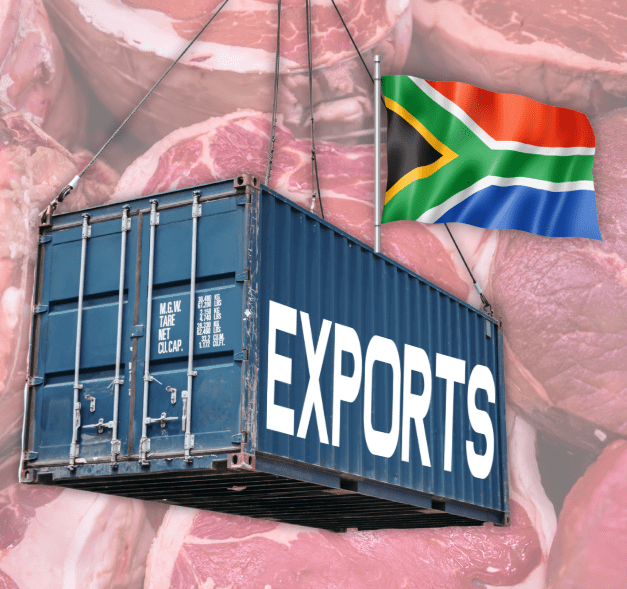
China’s blanket ban came early, before the national FMD collapse
A critical point often misunderstood is the timing of China’s suspension of South African beef imports.
China imposed its blanket ban in early May 2025, when FMD was still limited to a smaller number of provinces.
At that stage, KwaZulu Natal, Mpumalanga and Gauteng had confirmed cases, seven provinces were under surveillance, and South Africa was not yet fully FMD‑positive.
China acted early, consistent with its strict biosecurity posture. The later spread of FMD to all nine provinces did not cause the ban; it simply entrenched it.
This reinforces Olivier’s broader point that South Africa’s export challenges are not driven by external hostility but by internal weaknesses in disease control, certification and regulatory execution.
The real export barriers are internal, not external
Olivier is unequivocal that South Africa’s biggest export barriers are internal.
International demand for South African red meat is strong, particularly in the Middle East and Eastern Europe.
The problem lies in slow finalisation of health certificates, inconsistent SPS processes and ad hoc approvals. These internal delays cost the sector export opportunities and foreign exchange.
RMIS’s target is to increase exports from 4% to 20% of production by 2030. FMD has disrupted this trajectory, but the goal remains.
Vaccination rollout: progress, but still too slow
Olivier acknowledges that vaccine volumes are improving and that the system is “starting to stabilise to a certain effect”.
However, he highlights that vaccine manufacturing takes time, import volumes remain insufficient and rollout has been uneven. Practical issues such as bottle types, cold chain differences and unfamiliar packaging slowed early progress.
The key metric is not procurement but whether vaccines reach animals, and on this front the country is still behind.
Olivier notes that the sector and government have learned harsh lessons and are working together to improve efficiency, but the pace remains too slow to achieve the simultaneous herd immunity required for effective national control.
The High Court ruling: private vaccination becomes essential
The Pretoria High Court’s ruling that farmers may lawfully procure and administer FMD vaccines is a turning point.
The court found that government had no legal basis to block private procurement, that policy is not law and that the Minister and Director of Animal Health are interdicted from interfering in lawful commercial relationships.
This ruling aligns with Olivier’s emphasis on urgency. The state cannot vaccinate the national herd fast enough on its own. Private capacity is now legally unlocked and must be integrated into the national strategy.
If government embraces this ruling, South Africa can accelerate vaccination. If it resists or obstructs it, the crisis will deepen.
Rising fuel costs and logistics pressures compound the crisis
Olivier warns that rising fuel prices and transport disruptions are placing additional strain on an already pressured system.
Red meat logistics are fuel‑intensive, from moving animals and transporting feed to operating abattoirs, maintaining cold chains and delivering product to market. These costs cannot be fully absorbed by producers, especially in a constrained consumer environment.
Olivier believes the sector can improve operational efficiency through better route planning, load aggregation and reduced duplication, but he stresses that government reliability is equally important.
Predictable fuel supply, functional infrastructure and policy stability are essential for food security and sector sustainability.
Imports play a stabilising role, not a competitive threat
Olivier is clear that imports are not the enemy. They are a strategic stabiliser. Importers bring technical expertise in SPS compliance and international standards, which strengthens South Africa’s credibility.
They also contribute to skills development in cold chain management, logistics, quality assurance and traceability.
During outbreaks or supply shocks, imports help stabilise availability and prices without undermining local producers.
Olivier emphasises that imports must complement domestic production, not displace it, and that alignment between industry, regulators and traders is essential.
What needs to happen next
South Africa’s FMD crisis now threatens the stability of the red meat industry, the affordability of protein for consumers and the wider economy.
As Dewald Olivier stresses, the sector cannot recover without faster vaccination, stronger traceability and reliable regulatory systems.
Three priorities are urgent. Vaccination must accelerate through both public and private channels. Without rapid immunity, South Africa will remain shut out of high‑value markets and the virus will continue circulating.
Internal SPS processes must be fixed. Export demand exists, but South Africa cannot benefit while health certificates and approvals remain slow and inconsistent.
Government must also restore reliability in fuel supply, infrastructure and policy, as these are essential for logistics, cold chains and producer viability.
If these steps are not taken, the risks are clear. Producers will face deeper financial strain, more businesses will exit the sector, consumers will face higher prices, and the economy will lose further export revenue and rural jobs.
Dewald Olivier Image Credit: Rio Dirkson